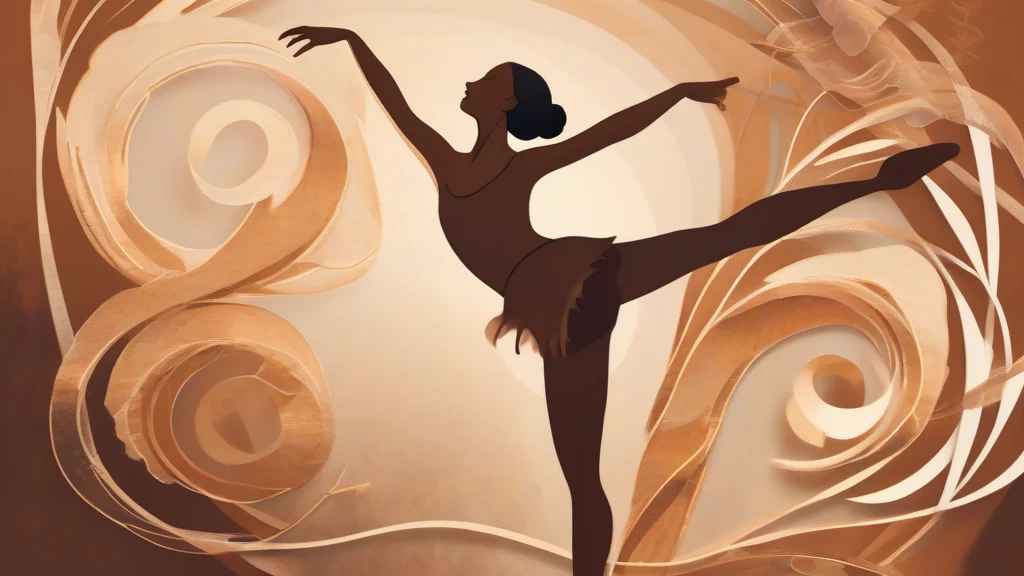
What does arabesque mean?
Arabesque is a noun with two principal meanings. In art and architecture, it denotes an ornamental pattern of intertwining foliage, tendrils, vines, and sometimes calligraphic lines, celebrated especially in Islamic and Moorish design, where flowing, repeating motifs cover surfaces such as walls, tiles, manuscripts, and metalwork. In classical ballet, an arabesque is a signature pose in which the dancer supports the weight on one leg while extending the other leg directly behind the body, often with the arms arranged to create a long, graceful line. The word can also function adjectivally, describing something decorated in this ornamental manner. Connotations lean toward elegance, intricacy, and refinement, whether describing a carved ceiling, a woven textile, or a dancer's silhouette against stage light. Because it bridges two very different domains—decorative art and performing dance—the word rewards writers seeking precision about either visual ornamentation or physical grace.
A decorative design featuring intertwined flowing foliage, tendrils, vines, or geometric lines, characteristic of Islamic and Moorish ornament.
"The ceiling was painted with arabesques that seemed to grow and curl endlessly across the plaster."
This is the original and still central sense of the word.
In ballet, a pose in which the dancer balances on one leg while extending the other leg straight back, creating an elongated line through the body.
"Her arabesque was so steady it looked as if she might hold it forever."
Commonly used without an article in casual speech about dance ('she does a beautiful arabesque').
Made or decorated in the style of an arabesque; characterized by intricate, flowing ornamentation.
"The book's binding featured arabesque scrollwork pressed into gilt leather."
Standard plural, used for multiple ornamental designs or repeated instances of the ballet pose.
"The mosque's tilework displayed dozens of interlacing arabesques in cobalt and gold."
Ballet borrowed 'arabesque' from Islamic art — the elegant one-legged pose is named after swirling vine patterns on palace walls.
Reviewed by Deb Chak, Editor. AI-assisted content curated by RJS Tech Solutions LLP.
Etymology of arabesque
Arabesque entered English in the mid-17th century, borrowed from French, which derived it from Italian 'arabesco', meaning 'Arabian' or 'in the Arabic style'. The underlying root is the word 'Arab' itself, reflecting European encounters with the ornamental traditions of the Islamic world, where depictions of living figures were often avoided in favor of flowing vegetal and geometric patterns. Cognates and related forms include 'Arabian' and other words built on the same root.
Related word forms
How arabesque is actually used
The noun is the dominant sense in general usage, referring both to decorative art and to the ballet position. The ballet sense is common in dance criticism and everyday speech among dance audiences. The adjectival use is comparatively rare and mostly appears in art-historical writing.
Easily confused with arabesque
An arabesque is a graceful flowing ornament of foliage and tendrils, whereas a grotesque is a bizarre or fantastically distorted figure or design.