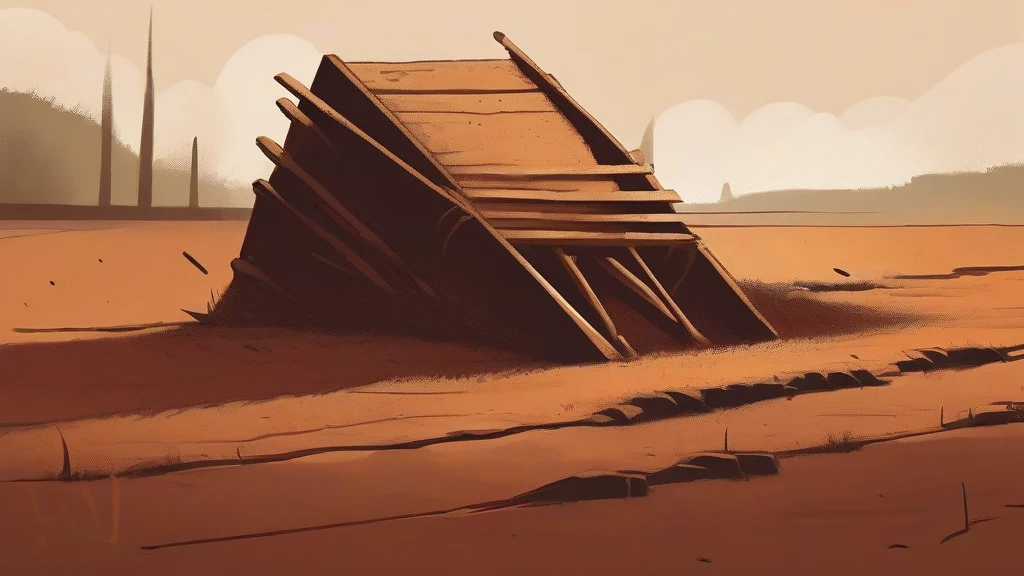
What does ard mean?
An ard is one of the oldest known implements for tilling soil: a simple plough consisting of a sturdy frame with a pointed wooden or metal share that is dragged through the ground, breaking and loosening it. Unlike a modern mouldboard plough, an ard does not invert the soil; it merely scratches furrows, making it well suited to light, stony, or dry soils where deeper turning would be wasteful or impractical. Ards have been used across the ancient Near East, Egypt, Europe, and Asia for many thousands of years, and depictions of them appear in Egyptian tomb art. Today the word survives mainly in archaeological and agricultural-history contexts, describing both surviving artefacts and traditional tools still used in some parts of the world. For readers interested in the history of farming, the ard represents the crucial first step in humanity's shift from gathering food to cultivating it.
nounAn ard is a simple, primitive plough consisting of a heavy pointed wooden or metal beam dragged through the soil to break and loosen the ground, without a mouldboard to turn the earth over.
- A primitive plough-like farm tool with a pointed beam used to scratch or loosen soil without turning it over.
"The farmer guided the ard behind his oxen, its wooden point carving shallow furrows into the dry earth."
"The archaeologists unearthed the remains of an ard, evidence of cultivation at the site thousands of years ago."
"In the highland field, two oxen pulled the ard while the crofter walked behind, steadying its handle."
The standard plural simply adds -s, following regular English noun pluralisation.
"Several bronze ard tips were recovered from the excavation site."
Before the modern plough existed, the ard was how humanity first broke open the earth to farm — a technology so old it appears in ancient Egyptian tomb paintings.
Reviewed by Deb Chak, Editor. AI-assisted content curated by RJS Tech Solutions LLP.
Etymology of ard
The English word "ard" was borrowed from Old Norse "arðr", which denoted the same primitive ploughing implement. The term entered medieval usage in Britain largely through Scandinavian influence in northern regions, where such tools were common. Its deeper origins are debated among scholars, so any connection to other Indo-European words should be treated cautiously.
How ard is actually used
The word is now largely historical and technical, encountered mainly in archaeology, agricultural history, and descriptions of traditional farming. It is not part of everyday modern vocabulary.
Easily confused with ard
"Hard" is a common adjective meaning solid or difficult, while "ard" is a noun naming an ancient digging and tilling implement.