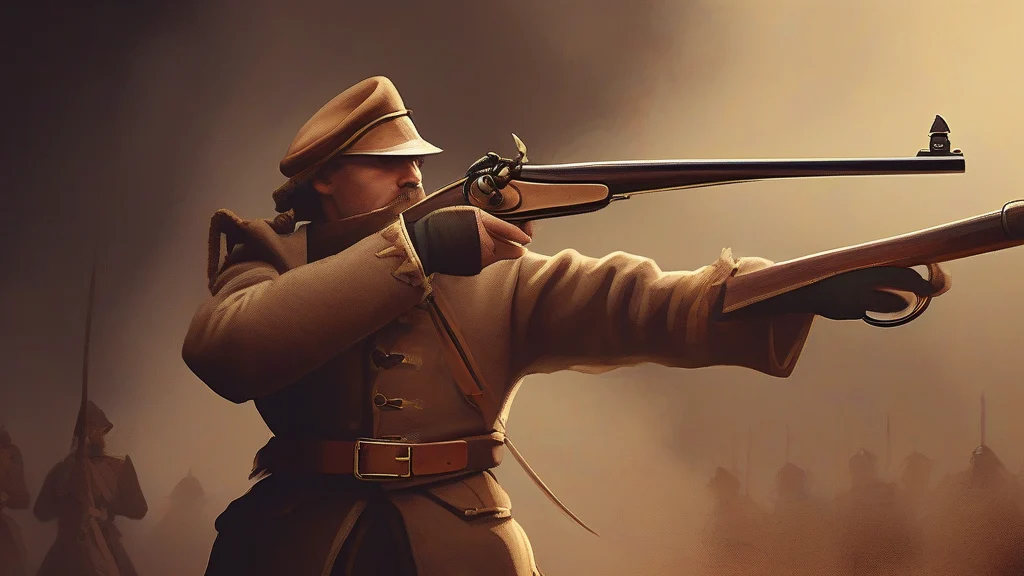
What does arquebusier mean?
An arquebusier was a foot soldier equipped with an arquebus, the heavy matchlock gun that dominated European battlefields from roughly the fifteenth through the seventeenth centuries. Because early arquebuses were cumbersome and ignited by a smoldering match cord, the arquebusier typically fought in disciplined ranks, often protected by pikemen, delivering coordinated volleys rather than aimed shots. The word entered English from French, which in turn drew on related Germanic terms for hook-guns, a reference to the hooked bar used to brace the weapon against recoil. Today 'arquebusier' survives almost entirely in military history, reenactment circles, and historical fiction, where it evokes the transitional era when gunpowder weapons began displacing the longbow and crossbow. It is a precise, evocative term: where 'musket' suggests later warfare, 'arquebusier' conjures the smoke, pikes, and plate armor of Renaissance battle.
nounA historical soldier armed with an arquebus, a heavy matchlock firearm of the 15th to 17th centuries.
- A soldier armed with an arquebus (historical).
"The Spanish arquebusiers fired in volleys from behind their pike men."
"At Pavia in 1525, Imperial arquebusiers shattered the flower of French chivalry."
"The museum's reconstruction shows an arquebusier bracing his weapon on a wooden rest before firing."
Regular plural; typically used when discussing units, ranks, or groups of these soldiers.
"Two hundred arquebusiers advanced under cover of the cavalry."
Before the word 'musket' took over, Europe's battlefields belonged to the arquebusier — a soldier whose weapon was so heavy it needed a forked rest and a slow-burning match just to fire.
Reviewed by Deb Chak, Editor. AI-assisted content curated by RJS Tech Solutions LLP.
Etymology of arquebusier
The word comes from French arquebusier, formed from arquebus ('arquebus') with the agent suffix '-ier'. French arquebus derives from Middle French adaptations of Germanic compounds such as Middle Dutch hakebusse, literally 'hook-gun', referring to the hook used to steady the weapon when firing. English also borrowed the parallel form harquebusier directly from the same source, giving the variant spelling still seen in older texts.
How arquebusier is actually used
The term is purely historical, encountered mainly in military history, museum contexts, and historical fiction; the variant spelling 'harquebusier' is also attested.
Easily confused with arquebusier
An arquebus is the firearm itself, while an arquebusier is the soldier who carries and fires it.