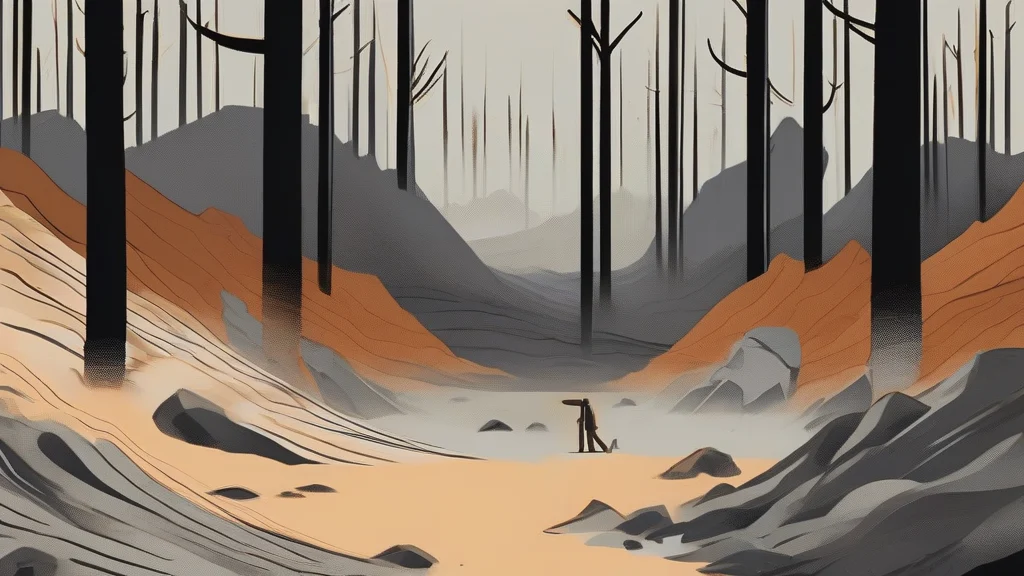
What does ash mean?
Ash is best known as the fine, grey powder left behind when organic matter such as wood, paper, coal, or tobacco has been completely burnt. In this sense it is treated as an uncountable substance, though the plural form "ashes" carries special weight when it refers to cremated remains, giving the word a solemn, even funerary connotation. A second important sense is geological: volcanic ash, made of tiny jagged fragments of rock and glass, can travel vast distances and disrupt air travel on a continental scale. Finally, ash names a tall hardwood tree of the genus Fraxinus, prized for its strong yet flexible timber, traditionally used for tool handles, sports equipment, and furniture. These senses are unrelated in origin, which makes ash a genuinely homonymous word rather than one with extended meanings. Whether describing what fire leaves behind, what a volcano throws into the sky, or the tree itself, ash is a compact, everyday word with surprising range and resonance.
The grey powdery residue left after the complete burning of wood, coal, tobacco, or other combustible material.
"He raked the cold ash out of the grate each morning."
Uncountable in general use; the plural "ashes" typically refers specifically to cremated human remains.
Fine particulate rock and glass ejected during a volcanic eruption, capable of drifting high into the atmosphere over long distances.
"The eruption blanketed nearby villages in a thick layer of volcanic ash."
A tall hardwood tree of the genus Fraxinus, having compound leaves and tough, elastic wood used for handles, furniture, and sporting goods.
"Baseball bats have long been turned from the straight-grained timber of the white ash."
Countable in this sense; more common in British usage.
As a mass noun, ash usually takes no plural; "ashes" is reserved chiefly for cremated remains, though it can describe scattered heaps of burnt residue in literary usage.
"Her ashes were scattered at sea, as she had requested."
In Norse mythology, the entire cosmos hangs on Yggdrasil — and that world-tree was believed to be an ash.
Reviewed by Deb Chak, Editor. AI-assisted content curated by RJS Tech Solutions LLP.
Etymology of ash
Ash comes from Old English, where the burnt-residue sense appeared as "asce" and the tree sense as "æsc." Both trace back through Germanic roots to Proto-Indo-European origins shared with cognates such as Old Norse "askr" (the ash tree) and Latin "ornus," a species of flowering ash. The two senses developed independently in the Germanic languages before converging into the single modern form, so their identical spelling is a historical coincidence rather than a shared meaning.
Related word forms
How ash is actually used
Ash is almost always uncountable when referring to burnt residue — you say "a layer of ash," not "ashes," unless speaking of human remains, where "ashes" (plural) is conventional. The tree sense is countable ("an ash," "three ashes") and appears mainly in British forestry and woodworking contexts.
Easily confused with ash
"Ash" names the substance itself or the tree, while "ashen" is an adjective describing a pale, greyish, deathly complexion.