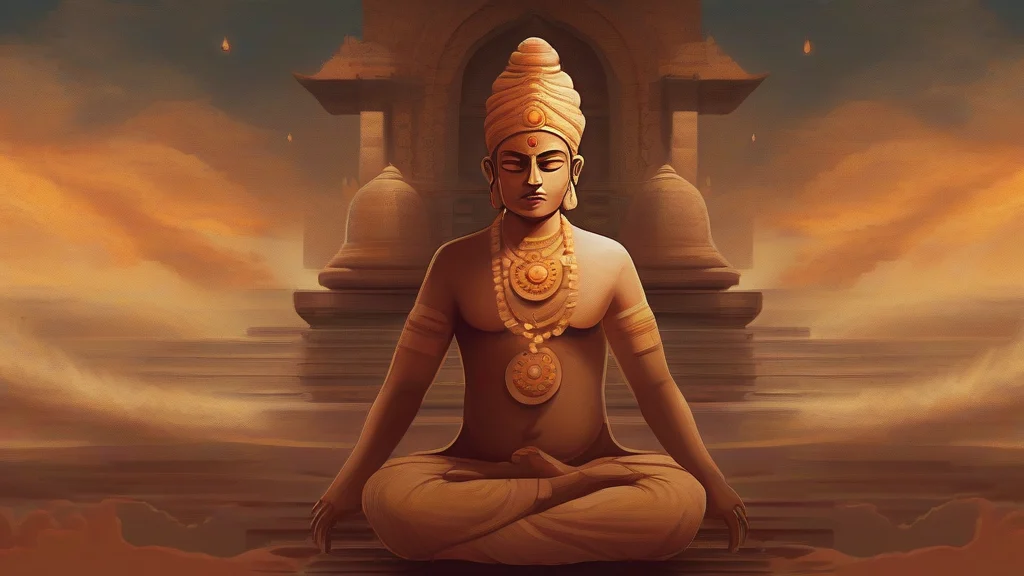
What does atma mean?
Atma is a noun borrowed from Sanskrit that denotes the soul or innermost self in Hindu thought — the enduring essence of a person as distinct from the body and mind. In classical Indian philosophy, especially the Vedantic schools, the atma is held to be eternal, uncreated, and ultimately identical with Brahman, the absolute reality, a teaching expressed memorably in the Upanishadic phrase 'tat tvam asi', 'thou art that'. The closely parallel Buddhist notion of anatta (non-self) arose partly in debate with this idea. In contemporary South Asian English, the word also appears more loosely to mean one's inner spirit or conscience, as in phrases like 'my atma told me'. The term derives from a very ancient root meaning 'breath' — the same root that gives English 'atmosphere' — reflecting the old intuition that the soul is the breath animating the body. It is used respectfully and mostly in spiritual or philosophical discussion.
nounIn Hindu philosophy, the individual soul or self — the innermost essence of a person, regarded as identical with ultimate reality (Brahman) in many schools of thought.
- The individual soul or self in Hindu (and by extension Buddhist) philosophy, considered the true essence of a person and, in Vedantic thought, ultimately one with Brahman.
- Loosely, in modern South Asian English, a person's inner spirit, conscience, or essential being, sometimes used in everyday or poetic contexts.
"Meditation, she explained, was her way of drawing closer to her atma."
"The Upanishads teach that the atma is unborn and undying."
"After years abroad, he felt his atma was still rooted in the village where he grew up."
Rarely pluralized; when needed, the regular English plural 'atmas' is used, since each person is traditionally understood to have one atma.
"The teacher said that all atmas share the same divine nature."
The English word 'atmosphere' traces back to the same ancient root as 'atma' — both come from a prehistoric word for breath, because in early thought the soul was the breath within you.
Reviewed by Deb Chak, Editor. AI-assisted content curated by RJS Tech Solutions LLP.
Etymology of atma
Atma comes from Sanskrit ātman, meaning 'breath, spirit, self', which scholars trace to a Proto-Indo-European root relating to breathing (*ēt-/h₂eth₂-). The shortened 'atma' form reflects Hindi and everyday South Asian pronunciation rather than strict scholarly transliteration, which gives 'atman'. A genuine Indo-European cognate survives in Greek 'atmos' ('vapor, breath'), the source of English 'atmosphere'; Germanic words for breathing are also connected. The word entered English usage alongside the study of Hinduism, becoming familiar through translations of Indian scripture and later through diaspora and New Age spiritual writing.
Related word forms
How atma is actually used
Atma is a loanword from Sanskrit via Hindi and other South Asian languages, so it appears mainly in religious, philosophical, and South Asian English contexts rather than general Western usage. It carries reverent, spiritual connotations and is not used casually. The fuller scholarly form is 'atman'.
Easily confused with atma
Atman is the standard Sanskrit transliteration of the same concept, while atma is a common Anglicized and Hindi-influenced spelling.