What does auger mean?
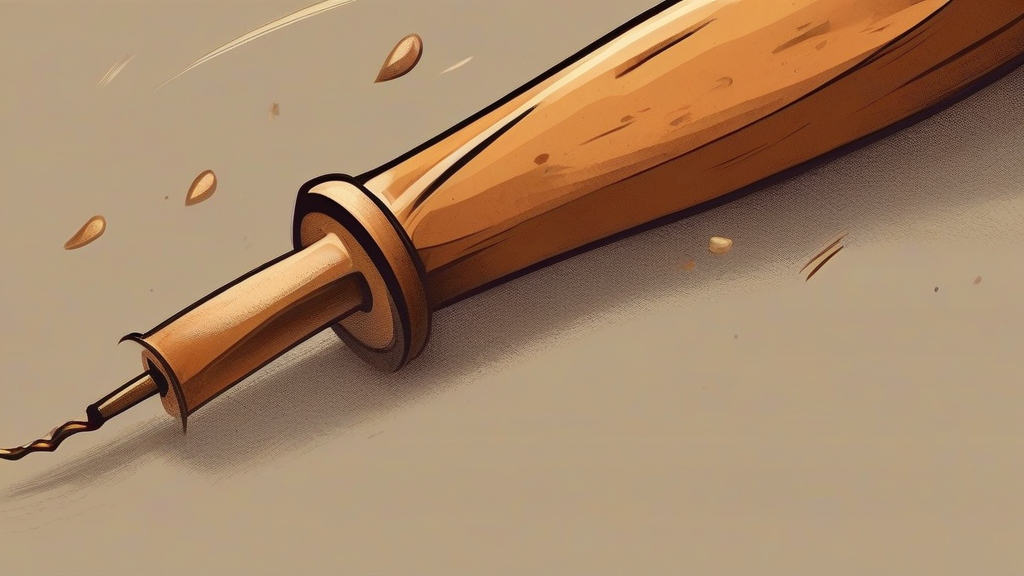
An auger is a hand or power tool designed to bore holes, built around a long metal shaft with a deep helical groove — resembling a giant screw — and a sharp cutting edge at its tip. As the auger rotates, the spiral flutes carry wood shavings or excavated soil back up and out of the hole, allowing it to cut cleanly and deeply. Augers come in many forms: small auger bits chucked into a carpenter's brace for boring timber, post-hole augers for fencing work, large earth augers mounted on machinery, and specialized ice augers used by anglers to drill fishing holes in frozen lakes. The noun appears most often in practical trades and outdoor contexts and carries no particular connotation beyond its literal sense. Learners of English should take care not to confuse it with "augur," which means to predict or foreshadow — a mix-up made easy by their identical pronunciation.
nounA carpenter's or farmer's tool consisting of a spirally twisted metal shaft with a cutting edge at the tip, used for boring holes in wood, soil, ice, or other materials.
- A tool with a spiral shaft and cutting edge, rotated to bore holes in wood, earth, ice, or similar materials.
"He used a hand-cranked auger to bore the post holes through the frozen ground."
"The carpenter fitted an auger bit into the brace and bored a clean hole through the oak beam."
"On the frozen lake, she drilled down with the ice auger until water welled up through the hole."
Regular plural, formed by adding -s. Used when referring to multiple tools or different types of augers.
"The workshop kept a range of augers on the wall, from slender gimlets to broad ship-builders' bits."
The word "auger" was born from a mistake: people misheard "a nauger" as "an auger," slicing off the first letter just as they did with "a napron" becoming "an apron."
Reviewed by Deb Chak, Editor. AI-assisted content curated by RJS Tech Solutions LLP.
Etymology of auger
"Auger" derives from Middle English "nauger," itself from Old English "nafogar," meaning a tool for boring the hub (nave) of a wheel. During the Middle English period the initial "n" was lost through misdivision of the phrase "a nauger" as "an auger," the same process that transformed "a napron" into "an apron." The Old English word shares a common Germanic root with "nave" (the central hub of a wheel) and, more distantly, with "navel."
How auger is actually used
"Auger" is a concrete, everyday noun found chiefly in woodworking, construction, gardening, plumbing, and fishing contexts. It is neutral in register. It is frequently confused in writing with "augur," so care with spelling matters. The word is almost always countable.
Easily confused with auger
An 'auger' is a drilling tool, while an 'augur' is a person who predicts events or omens (as a verb, to foretell); the two are unrelated in meaning despite near-identical spelling and pronunciation.