What does auricula mean?
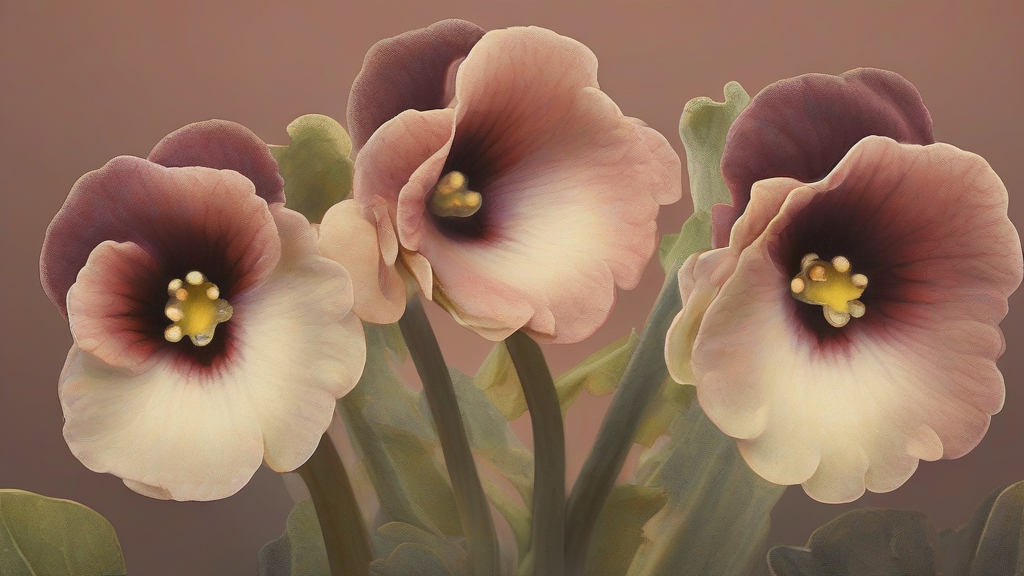
The auricula is a small, hardy perennial of the primrose family, Primula auricula, native to the mountains of central Europe. It bears rosettes of thick, fleshy leaves and clusters of fragrant, typically yellow flowers, though centuries of cultivation have produced show forms in an extraordinary range of colours — dusty greens, greys, maroons, and banded petals. The name comes from Latin, meaning literally 'little ear', a reference to the shape of its leaves, and it is sometimes known as the bear's-ear. Auriculas hold a particular place in British horticulture, where they were fashionable from the seventeenth century onward and were once displayed in purpose-built tiered structures called auricula theatres. Today they remain collector's plants, cherished for their powdery farina-covered blooms and their rich history among florists' flowers. A secondary, chiefly historical sense uses 'auricula' for any ear-shaped anatomical structure.
A European alpine primrose (Primula auricula) with fleshy leaves and fragrant flowers, cultivated in many ornamental varieties.
"The florist's pride and joy was a tray of rare auriculas raised from cuttings."
In gardening circles the plural is often simply 'auriculas'; the Latin plural 'auriculae' also appears.
(Anatomy/Biology) An ear-shaped structure or part, such as a lobe or appendage; now usually termed an auricle.
"Early anatomists labelled the small ear-shaped appendage as an auricula."
The anglicized plural 'auriculas' is standard in everyday gardening use; the Latin plural 'auriculae' appears in more formal or botanical writing.
"Her auriculas won first prize at the spring flower show."
Victorian gardeners were so obsessed with auriculas that they built special 'auricula theatres' — tiered stages to show off each prized bloom like a performer.
Reviewed by Deb Chak, Editor. AI-assisted content curated by RJS Tech Solutions LLP.
Etymology of auricula
Auricula comes directly from Latin auricula, the diminutive of auris ('ear'), meaning 'little ear', adopted into English in the seventeenth century. The name originally referred to the ear-like shape of the plant's leaves, and the same Latin root gives English words such as auricle and auricular. The word's application narrowed over time to designate specifically Primula auricula, the mountain primrose beloved of plant collectors.
How auricula is actually used
Most common in British gardening contexts, where auriculas are treated as specialist show plants with a devoted following; the anatomical sense is now rare, having largely been replaced by 'auricle'.
Easily confused with auricula
The auricle is the visible outer part of the ear (or an ear-shaped anatomical structure), while the auricula is primarily a flowering plant of the primrose family.