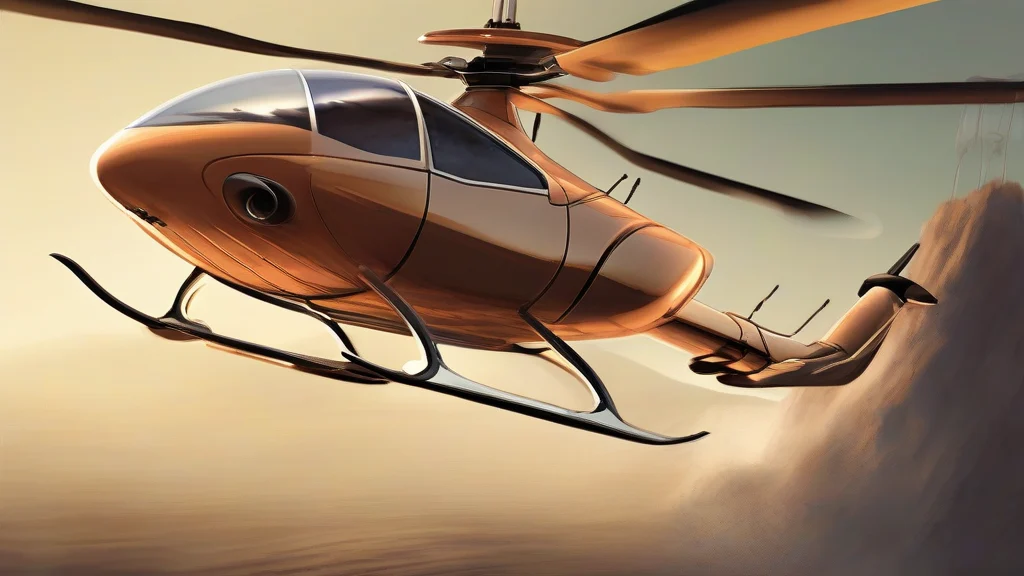
What does autogyro mean?
An autogyro, also spelled autogiro and sometimes called a gyroplane or gyrocopter, is a type of rotorcraft that occupies a middle ground between aeroplanes and helicopters. It carries a large, freely spinning rotor on top of its fuselage that is not driven by the engine; instead, air flowing up through the blades as the craft moves forward keeps them turning, generating lift. Propulsion comes from a conventional engine-driven propeller, usually at the front or rear. Because its rotor cannot stall in the way a fixed wing can, an autogyro can fly remarkably slowly and descend steeply and safely, though it cannot hover like a true helicopter. The type was pioneered in the 1920s by Spanish engineer Juan de la Cierva, and modern lightweight autogyros remain popular among sport pilots and for specialized tasks such as aerial observation.
nounA type of rotorcraft in which an unpowered, freely rotating rotor provides lift while a conventional engine-driven propeller supplies forward thrust; distinct from a helicopter, whose rotor is powered.
- A rotary-wing aircraft with an unpowered rotor providing lift and an engine-driven propeller providing thrust.
"The pilot took off from the short grass strip in a small autogyro and circled slowly over the valley."
"Cierva's early autogyros of the 1920s proved that rotating wings could keep an aircraft aloft at very low speeds."
"She earned her licence in an autogyro before ever flying a fixed-wing plane."
Regular plural; simply add -s. The alternate spelling "autogiro" pluralizes identically.
"Several vintage autogyros were parked along the flight line at the airshow."
Invented by Spanish engineer Juan de la Cierva after a fatal crash of his own three-engine bomber, the autogyro could fly so slowly it was once famously landed on the lawn of the White House.
Reviewed by Deb Chak, Editor. AI-assisted content curated by RJS Tech Solutions LLP.
Etymology of autogyro
The word "autogyro" combines two elements of Greek origin: "auto-", meaning self, and "gyro-", from the Greek "gyros" meaning circle or ring. It was coined in the early twentieth century as a trade name for Juan de la Cierva's rotary-wing aircraft, which is why the spelling "autogiro" is also well established. The same Greek root "gyros" gives English related words such as "gyrate" and "gyre," while "auto-" appears widely in terms like "automatic" and "autonomous."
How autogyro is actually used
Also spelled "autogiro" (originally a de la Cierva trademark) or "gyroplane"; "gyrocopter" is a more informal, often generic term. The word is technical and appears mostly in aviation contexts.
Easily confused with autogyro
An autogyro's rotor spins freely from airflow and provides only lift, whereas a helicopter's rotor is engine-powered and provides both lift and propulsion.
A gyroscope is a spinning device used for orientation and stability, while an autogyro is an aircraft whose name derives from the Greek word for circle, not from the instrument itself.