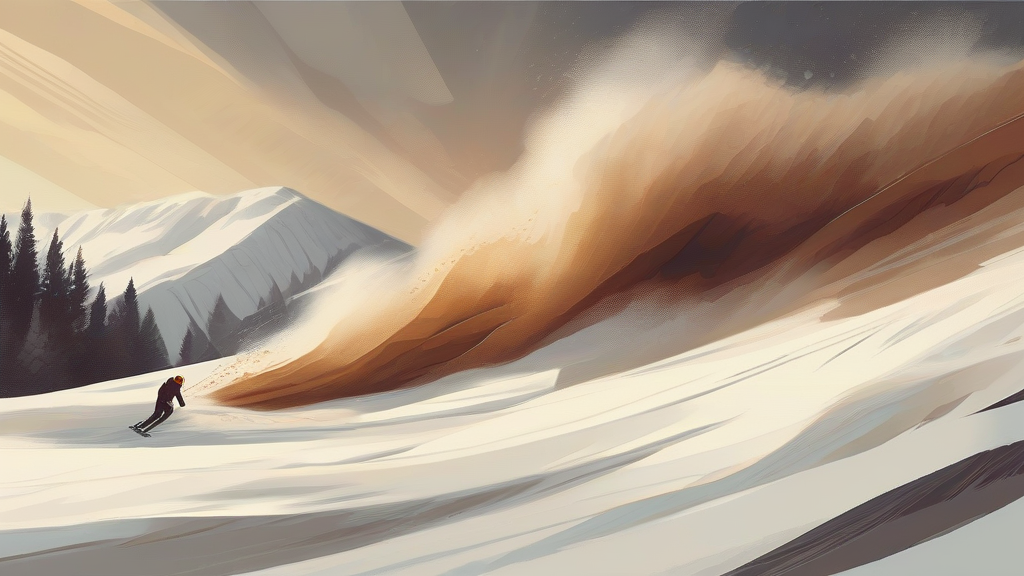
What does avalanching mean?
Avalanching is the present participle of the verb 'to avalanche', describing a sudden, massive descent or rush — most literally of snow, rock, or debris sliding down a mountainside. By extension, it captures any overwhelming, self-reinforcing surge: emails avalanching into an inbox, customers avalanching toward a sale, or criticism avalanching onto a public figure after a misstep. The word carries connotations of speed, scale, and irresistibility; whatever is avalanching cannot easily be stopped mid-flow. Beyond everyday and figurative use, avalanching has a precise technical life in electronics, where it names the cascade of multiplying charge carriers known as avalanche breakdown in diodes and other semiconductor devices. Derived from the noun 'avalanche' — ultimately from the French, with roots traced to Alpine dialects — it is a vivid choice when a writer wants motion, mass, and momentum rather than mere accumulation.
To fall, slide, or rush down in the manner of an avalanche; figuratively, to arrive or accumulate in an overwhelming flood.
"Boulders were avalanching down the cliff face after the earthquake."
Often used with directional prepositions such as 'down' or 'into'.
In semiconductor physics, to undergo avalanche breakdown, whereby charge carriers multiply explosively under a strong electric field.
"At high reverse bias, the junction begins avalanching, producing a sharp rise in current."
Physicists borrowed the word for electrons: in a semiconductor, a single electron can trigger an 'avalanche' that multiplies into millions — electricity literally avalanching through silicon.
Reviewed by Deb Chak, Editor. AI-assisted content curated by RJS Tech Solutions LLP.
Etymology of avalanching
Avalanching derives from the noun 'avalanche', which entered English from French in the late eighteenth century. The French word itself comes from the Savoyard/Romansh dialects of the Alps, evolving from earlier forms such as 'lavange' and 'lavina', of uncertain deeper origin though often linked to Latin 'labes' ('a fall, slide') via Vulgar Latin *lavina. The verb 'to avalanche' developed by conversion from the noun, and its present participle 'avalanching' follows naturally; twentieth-century physics extended the term to describe cascading particle multiplication in electric fields.
Related word forms
How avalanching is actually used
Mostly formal-to-neutral register; the literal mountaineering sense is common in technical and news contexts, while figurative use emphasizes overwhelming, unstoppable volume. In electronics, 'avalanching' is standard technical jargon for carrier multiplication.
Easily confused with avalanching
Coalescing means merging together into a whole, whereas avalanching means a sudden, massive downward rush or cascade.