
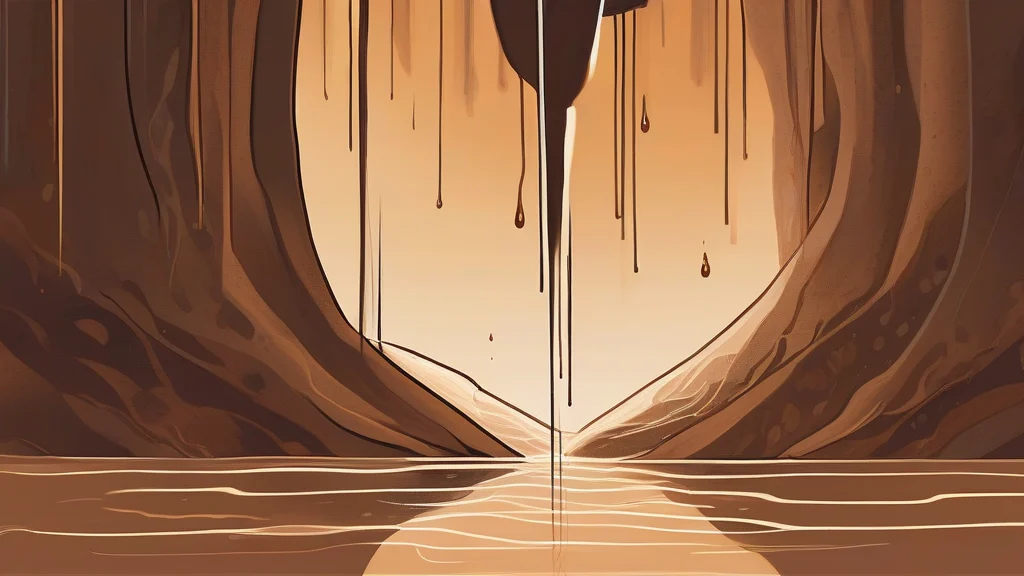
What does trickling mean?
“Trickling” describes a slow, thin flow, especially the movement of water through a narrow opening or over a surface. It can also describe something arriving or increasing gradually: support, complaints, or new subscribers may be said to trickle in. The word is useful because it conveys both physical movement and a gradual pace, often suggesting that the flow is modest, steady, and difficult to stop. In phrases such as “trickling water” and “a trickling stream,” it focuses on the narrowness and softness of the flow. Figurative uses retain that sense of limited, gradual movement: “Visitors began trickling into the exhibition.” “Trickling” is related to the verb “trickle,” but as a present participle it is especially natural immediately before a noun or after a form of “be.” It is equally familiar in British and American English and is not limited to a specialized register.
To flow or move slowly in a thin stream or in small amounts; figuratively, to arrive or develop gradually.
"The tap had been trickling for several minutes before the plumber arrived."
The figurative sense commonly appears with “in” or “out,” as in “subscribers trickled in.”
Flowing slowly in a thin stream or occurring gradually in small amounts.
"The roof was leaking, and trickling water formed a pool beneath the bucket."
This attributive use is especially common with “water,” “rain,” and “stream.”
The action or result of flowing slowly in a thin stream.
"They listened to the trickling of water through the pipes."
The noun use is usually a gerund construction and has no regular plural form.
A trickle can become a flood—and that slow, steady movement is what “trickling” captures.
Reviewed by Deb Chak, Editor. AI-assisted content curated by RJS Tech Solutions LLP.
Where does trickling come from?
The word descends from Middle English “triken,” meaning to flow or run in a small stream. Its deeper origin is uncertain, and the modern form developed through the regular verb “trickle,” with “-ing” expressing ongoing action.
Related word forms
How trickling is actually used
The literal sense is commonly used with water, rain, and other liquids, while the figurative sense suggests a gradual, limited increase or arrival. It is neutral in register and common in both British and American English.
Easily confused with trickling
Tinkling describes a light, ringing sound, whereas trickling describes liquid or another substance moving in a thin stream.