What does awninged mean?
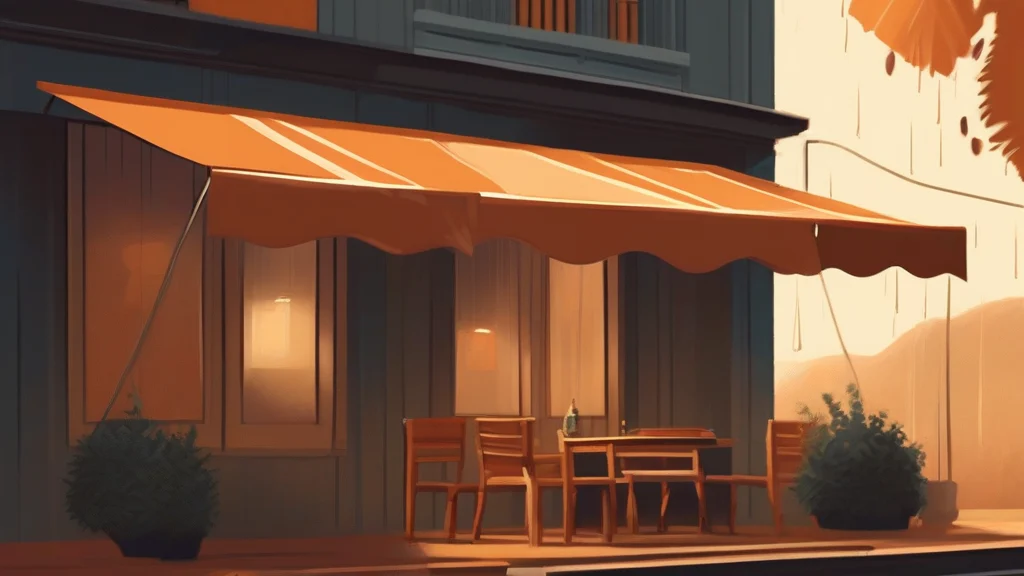
Awninged is a descriptive adjective meaning covered by, or furnished with, an awning — the sloping canvas or fabric canopy that projects from a wall to shield windows, doorways, and outdoor spaces from sun or rain. The word appears most often in travel writing, architectural description, and evocative literary prose, where it lends scenes a specific visual texture: an awninged café suggests leisurely continental charm, while an awninged shopfront implies a traditional streetscape. Because it describes a built feature rather than a person or abstract idea, it nearly always modifies nouns of place such as terraces, porches, balconies, and entrances. Though not among the most frequently used English adjectives, it is a precise and useful term for writers who want to convey shelter, shade, and a certain old-world atmosphere in a single word. It derives simply from the noun 'awning', combined with the adjective-forming suffix '-ed'.
adjectiveCovered or sheltered by an awning; furnished with a canopy projecting from a wall to provide shade or protection from rain.
- Covered or shaded by an awning, as a window, doorway, terrace, or street frontage.
"They lingered over coffee on the awninged terrace long after sunset."
"The awninged storefronts along the promenade gave the street a distinctly Mediterranean feel."
"Guests were seated at tables beneath the hotel's awninged veranda, safe from the afternoon drizzle."
The word 'awning' itself has a famously murky origin — even lexicographers admit they aren't sure where it came from.
Reviewed by Deb Chak, Editor. AI-assisted content curated by RJS Tech Solutions LLP.
Etymology of awninged
Awninged is formed directly from the noun 'awning' plus the adjectival suffix '-ed', in the same way that 'windowed' comes from 'window'. The underlying noun 'awning' first appears in English in the early 17th century, but its deeper origins remain genuinely uncertain; dictionaries note possible connections to French 'auvent' (a hood or canopy) while acknowledging that no derivation has been conclusively established. Whatever its ultimate source, the word became firmly associated with the canvas canopies of ships and shopfronts, and the adjective 'awninged' emerged as a natural descriptive derivative for anything so covered.
Related word forms
How awninged is actually used
A relatively uncommon descriptive adjective, typically used in travel writing, architecture, and literary prose rather than everyday conversation. It almost always modifies places — cafés, terraces, windows, shops — rather than people or objects.
Easily confused with awninged
'Awninged' means covered by a fabric roof-like shade, while 'awned' is a botanical term describing grasses and grains that bear bristle-like appendages called awns.