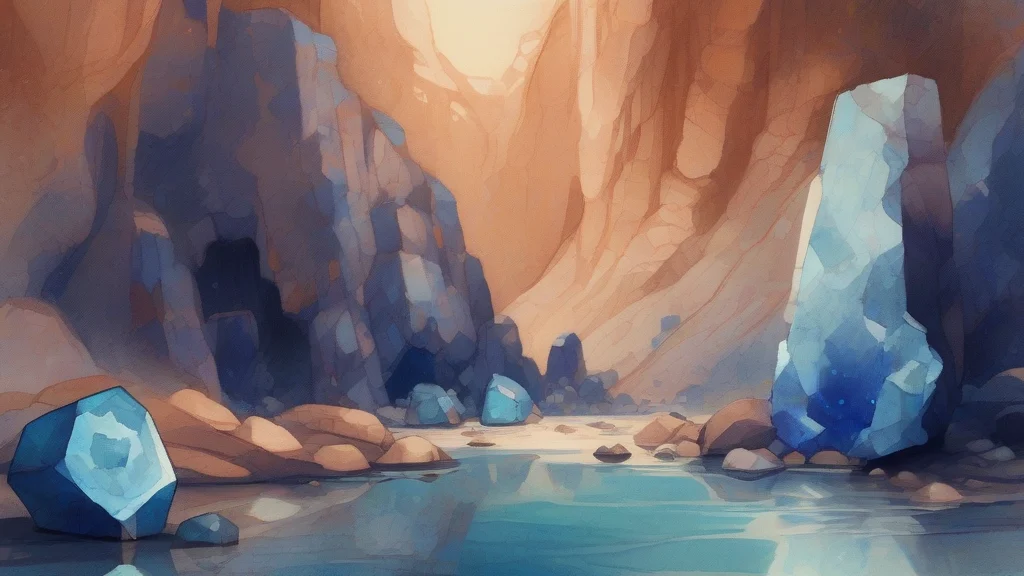
What does azurite mean?
Azurite is a deep blue copper mineral — a hydrated copper carbonate — prized since antiquity both as a semi-precious stone and as a source of blue pigment. Its name derives from the Persian-derived word 'azure', a nod to its striking sky-blue colour. Before synthetic blues became available, artists ground azurite into powder to make paint: it was a staple of medieval and Renaissance European painting, valued for producing rich, luminous blues at lower cost than genuine ultramarine. Over time, exposed azurite pigment can chemically alter into green malachite, a transformation occasionally visible in centuries-old paintings. Mineralogists also value azurite for the beautiful, well-formed dark-blue crystals found in copper deposits around the world, notably in France, Namibia, Arizona, and Mexico. Today the word appears mainly in geology, art history, and jewellery contexts, where it denotes a substance associated with depth of colour, antiquity, and natural beauty.
nounA deep blue copper mineral, hydrated copper carbonate, used as a pigment and as a semi-precious gemstone.
- The deep blue copper mineral (hydrated copper carbonate) used as a pigment and gemstone.
"The Renaissance painter ground azurite into a pigment to achieve the rich blue of the Virgin's robes."
"Veins of brilliant azurite ran through the copper deposit, its crystals glittering under the miner's lamp."
"Conservators discovered that the sky in the altarpiece had been painted with azurite rather than the costlier ultramarine."
Rarely used; azurite is typically treated as an uncountable mass noun. The plural appears mainly in contexts describing multiple distinct specimens or occurrences.
"The dealer displayed several fine azurites from different mines."
Renaissance masters prized azurite so highly that it was sometimes more expensive than gold leaf — and over centuries it slowly 'weathered' into green malachite inside old paintings.
Reviewed by Deb Chak, Editor. AI-assisted content curated by RJS Tech Solutions LLP.
Etymology of azurite
The word 'azurite' derives from 'azure', ultimately tracing back through Arabic 'lāzaward' to Persian 'lāžward', referring to lapis lazuli and its characteristic blue colour. The English word 'azure' entered via Old French in the medieval period, and 'azurite' was formed from it in the 19th century when the mineral was formally named. It shares this linguistic lineage with words such as 'lazuli' and 'lazurite', all pointing to the same ancient association between the colour blue and precious stones.
How azurite is actually used
Azurite belongs to the technical vocabulary of mineralogy, geology, art history, and gemmology. It is a formal term, rarely used in casual conversation, and carries connotations of rarity, antiquity, and artistic craftsmanship. In art-historical contexts it is frequently discussed in relation to ultramarine, which it partly replaced or complemented as a blue pigment.
Easily confused with azurite
Lapis lazuli is a rock composed mainly of the mineral lazurite with pyrite flecks, whereas azurite is a single copper carbonate mineral; both are deep blue but lapis often shows gold-coloured pyrite specks.
Malachite is a green copper carbonate closely related chemically to azurite and often found alongside it, while azurite is characteristically deep blue.