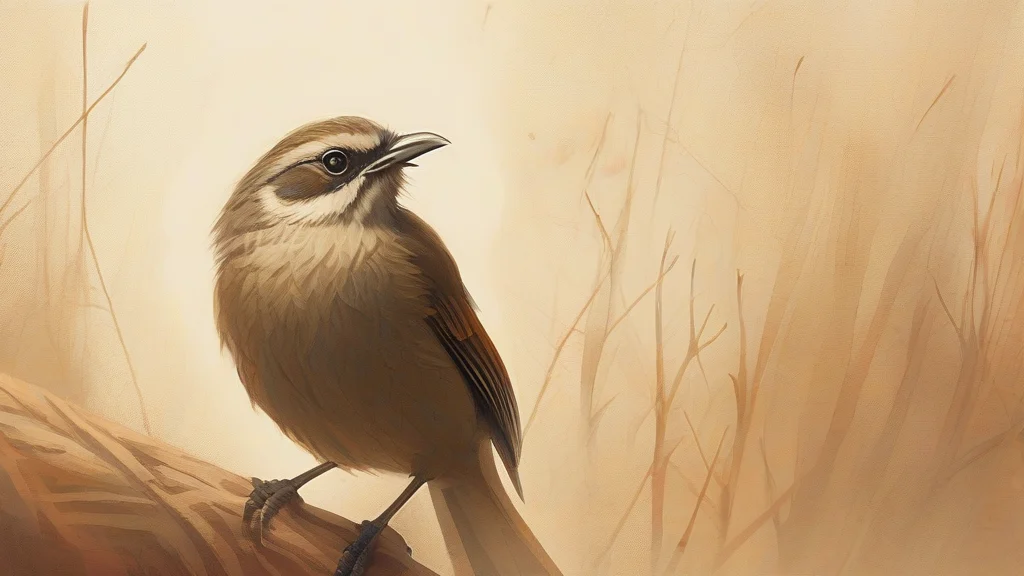
What does babbler mean?
A babbler is, most commonly, a person who talks too much—someone whose speech flows constantly and often pointlessly, whether out of nervousness, indiscretion, or simple love of conversation. The label carries a mildly disapproving tone, implying that the talker says little of substance or lets secrets slip too easily, though it stops short of accusing anyone of malice. The word also has an entirely separate life in ornithology, where it designates any of numerous gregarious Old World songbirds celebrated for their constant, noisy calling; species such as the jungle babbler and the arrow-marked babbler live in cooperative flocks that chatter almost without pause. Both senses trace back to "babble," a verb of imitative origin describing incoherent, murmuring speech. In everyday use, calling someone a babbler is a compact way of saying their words outrun their meaning—a useful shorthand in a world where everyone knows at least one.
A person who talks continuously, rapidly, or foolishly, especially about trivial matters.
"She avoided discussing her plans within earshot of the office babbler."
Mildly derogatory; suggests verbosity or indiscretion rather than ill intent.
Any of various gregarious, noisy songbirds of the Old World tropics, long grouped in the family Timaliidae and now spread across several families.
"Jungle babblers foraged together through the garden, keeping up an unbroken chorus of calls."
Standard plural; used both for multiple people and, frequently in ornithological writing, for flocks or groups of the birds.
"A dozen jungle babblers descended on the lawn in search of insects."
The word babbler describes both the coworker who won't stop talking and a family of famously chatty birds—nature apparently named them twice.
Reviewed by Deb Chak, Editor. AI-assisted content curated by RJS Tech Solutions LLP.
Etymology of babbler
Babbler derives from "babble," a Middle English verb attested by the thirteenth century, which arose as an imitative formation echoing the sound of unintelligible murmuring speech. Similar imitative forms appear across Germanic languages, such as Dutch "babbelen" and German "babbeln," reflecting a shared instinct to mimic the sound being described. The noun form, denoting a habitual babbler, emerged in English during the sixteenth century, while the ornithological sense was applied later to the conspicuously vocal birds of Asia and Africa.
Related word forms
How babbler is actually used
When applied to people, the term carries a mildly negative connotation, suggesting tiresome or indiscreet talk rather than malicious gossip; "chatterbox" is a more affectionate alternative. In ornithology, "babbler" covers many genera across several families, so it denotes a loose group rather than a single taxonomic unit.
Easily confused with babbler
"Babble" refers to the act or sound of rapid, incoherent talk (or a baby's early vocalizations), whereas "babbler" names the person—or bird—who does the babbling.