What does babiroussa mean?
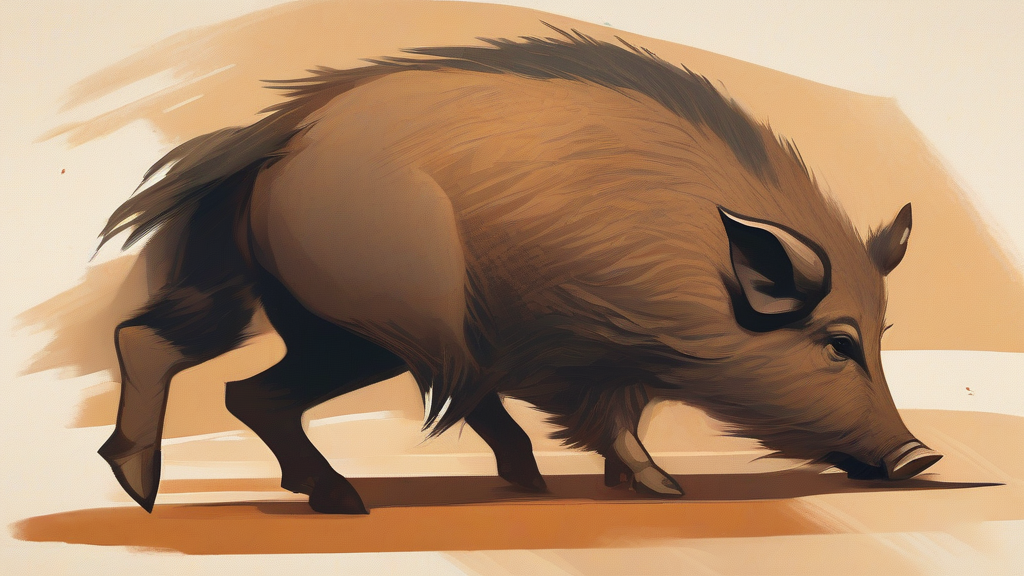
The babiroussa is a large, remarkable wild pig native to the Indonesian island of Sulawesi and a few nearby islands. Its most striking feature is borne by the male: the upper canine teeth do not project downward like ordinary tusks but grow vertically, piercing the skin of the snout and curving backward toward the animal's forehead. This unusual anatomy led Malay-speaking peoples to call the creature 'babi-rusa' — literally 'pig-deer' — a name European naturalists adopted as the word babiroussa. In English usage the term appears mainly in older zoological texts and natural-history writing; contemporary scientific literature generally prefers the spelling 'babirusa'. Because of habitat loss and hunting on Sulawesi, the species is regarded as threatened, making the babiroussa a subject both of biological fascination and of conservation concern.
nounA large wild pig of the East Indian islands (especially Sulawesi), the male of which has long upward-curving upper canine teeth that pierce through the skin of its snout.
- A wild pig of Sulawesi and nearby Indonesian islands, noted for the male's tusk-like upper canines that penetrate the upper lip.
"The male babiroussa's extraordinary tusks curve backward toward its own forehead."
"The male babiroussa's upper canine teeth grow upward through the flesh of its snout, curving elegantly back toward its skull."
"Conservationists working in Sulawesi are striving to protect the babiroussa, whose rainforest habitat is steadily shrinking."
The regular plural is standard; the uninflected form "babiroussa" is rare.
"Several babiroussas were observed wallowing near the riverbank."
The babiroussa's upper tusks grow straight through its snout and curl back toward its eyes — so much so that Malays named it 'babi-rusa', literally a 'pig-deer'.
Reviewed by Deb Chak, Editor. AI-assisted content curated by RJS Tech Solutions LLP.
Etymology of babiroussa
The word babiroussa derives from Malay, combining 'babi' (pig) and 'rusa' (deer), reflecting the animal's deerlike tusks. The name entered English in the late eighteenth century through Dutch colonial accounts of the East Indies, where it was applied to the peculiar pigs of Sulawesi. Modern English also uses the respelled form 'babirusa', drawn directly from the same Malay elements.
How babiroussa is actually used
The word is somewhat dated or scholarly; modern zoological writing more often uses the spelling "babirusa". It is used almost exclusively in natural-history and zoological contexts.
Easily confused with babiroussa
A warthog is an African pig with facial warts and outward tusks, whereas the babiroussa is an Indonesian pig whose upper tusks grow up through its snout.