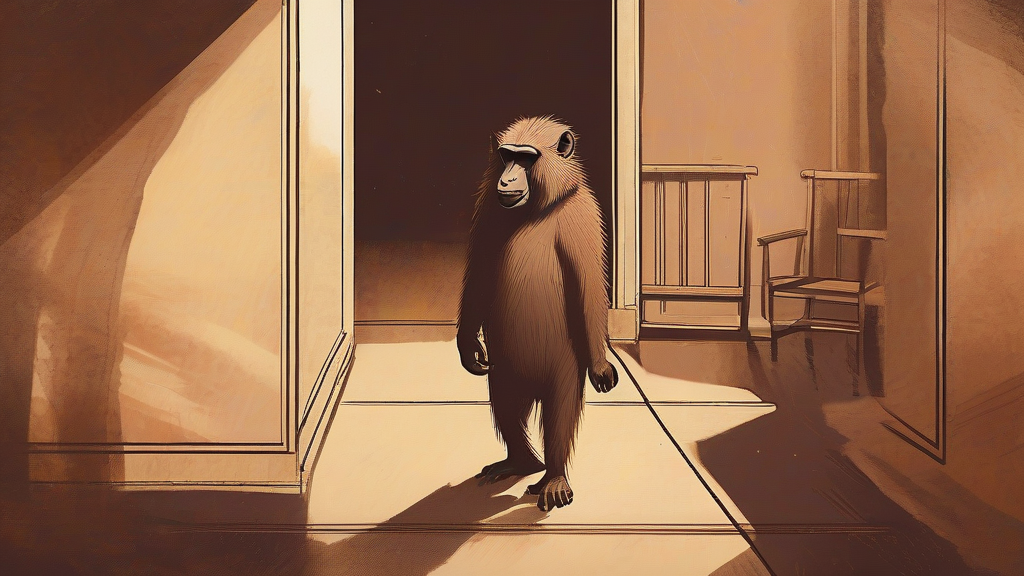
What does baboonish mean?
Baboonish is a rare English adjective used to describe something that resembles a baboon, either in appearance or in behavior. Applied to looks, it suggests protruding features, a heavy jaw, or a generally simian cast of countenance; applied to conduct, it implies rowdy, coarse, or clownish behavior more fitting to a primate than a person. The word derives straightforwardly from 'baboon,' the large ground-dwelling monkey of Africa and Arabia, combined with the common suffix '-ish,' which forms adjectives meaning 'having the character of.' It belongs chiefly to literary and journalistic prose, where writers reach for it when they want a vivid, faintly comic note of ugliness or absurdity. Because it is informal and often mildly insulting when aimed at people, it is best reserved for descriptions of caricatures, expressions, or unruly scenes rather than polite conversation. Though uncommon, it remains a useful color word for anyone wanting a precise term for crudely ape-like traits.
adjectiveResembling a baboon in appearance or manner; by extension, crudely ugly, coarse, or clownishly absurd.
- Resembling a baboon in physical appearance, especially in having protruding features or a long muzzle.
- Behaving in a crude, boisterous, or clownishly foolish way, as if like a baboon.
"He pulled a baboonish face at the camera, baring his teeth for effect."
"The caricature gave the politician a distinctly baboonish profile, all jutting jaw and heavy brow."
"Their drunken whooping grew so baboonish that other diners began to stare."
English lets you turn almost any animal into an insult just by adding '-ish' — and baboonish has been quietly doing that job since the 1800s.
Reviewed by Deb Chak, Editor. AI-assisted content curated by RJS Tech Solutions LLP.
Etymology of baboonish
Baboonish is formed directly from 'baboon,' a word English borrowed from French 'babouin,' which itself traces back through medieval Latin to an Old French or Germanic root associated with yawning or grimacing. The adjective was created with the familiar English suffix '-ish,' which turns nouns into adjectives meaning 'of the nature of.' The compound appears in English writing from roughly the nineteenth century onward, joining a long tradition of animal-plus-'-ish' formations used to characterize human appearance or behavior. Its closest relatives are simply the noun 'baboon' itself and similar animal-derived adjectives such as 'owlish' and 'piggish.'
How baboonish is actually used
Rare and informal, baboonish appears mostly in descriptive or mildly mocking prose rather than everyday conversation. It can carry an unflattering connotation when applied to people's looks or manners, so it should be used with care in polite contexts.
Easily confused with baboonish
A baboon is the large African and Arabian monkey itself, whereas baboonish is an adjective describing anything that resembles a baboon or is crudely ape-like.