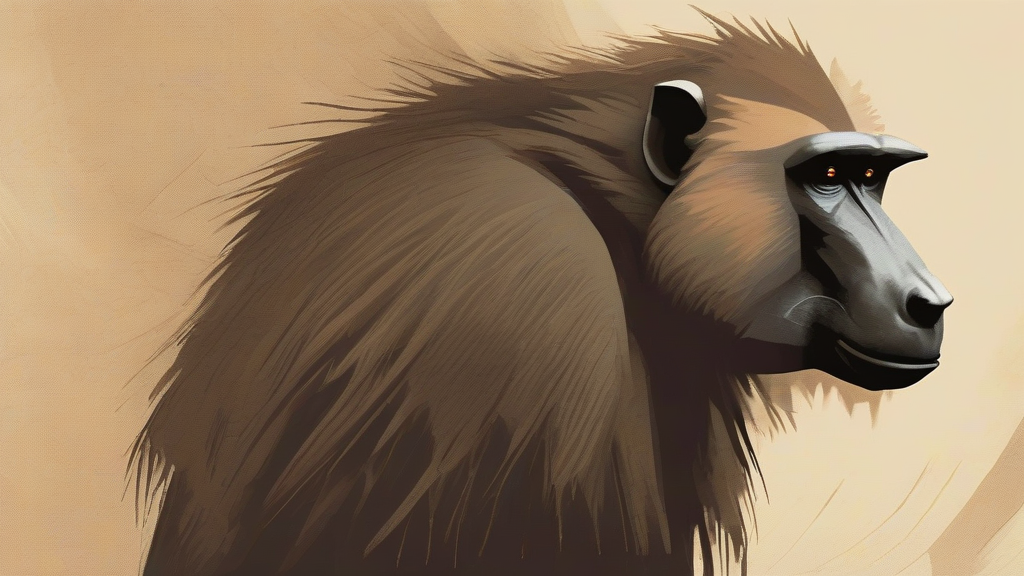
What does baboon mean?
A baboon is a large, ground-dwelling monkey belonging to the genus Papio, native to Africa and parts of Arabia. Baboons are among the largest of all monkeys, distinguished by their elongated, dog-like muzzles, powerful limbs, thick fur, and—particularly in females—inflated hairless pads on their rumps. They live in structured social groups called troops, which can number dozens or even hundreds of individuals, and they are highly adaptable, occupying savannas, woodlands, and even areas near human settlements. The word is occasionally applied figuratively to describe a person as coarse, rowdy, or ill-mannered, a usage that carries an insulting connotation and should be handled with care. Beyond its biological meaning, 'baboon' has rich cultural resonance: in ancient Egypt, baboons were linked to Thoth, the god of wisdom and writing, and were mummified in vast numbers. Whether encountered in wildlife documentaries, zoology texts, or everyday speech, the word evokes an animal that is intelligent, socially complex, and unmistakably distinctive.
A large, terrestrial Old World monkey of the genus Papio (or closely allied genera), native to Africa and Arabia, having a dog-like muzzle, bare callous buttocks, and living in social troops.
"Vervet monkeys scattered as a troop of chacma baboons descended on the waterhole."
'Baboon' may refer collectively to any of several species, including the olive, yellow, chacma, Guinea, and hamadryas baboons.
(Informal, derogatory) An uncouth, coarse, or stupid person.
"Stop acting like a baboon and apologize to your sister."
This figurative sense is informal and insulting; avoid it in formal writing.
Standard plural; no alternative plural form exists.
"Several baboons lounged near the riverbank at dusk."
In ancient Egypt, baboons were so revered that they were mummified by the thousands and associated with Thoth, the god of wisdom.
Reviewed by Deb Chak, Editor. AI-assisted content curated by RJS Tech Solutions LLP.
Etymology of baboon
The English word 'baboon' derives from the Middle French 'babuin', which appeared in the 13th century and was borrowed into English by the early 16th century. The ultimate origin of the French term is uncertain; one traditional suggestion connects it to 'babine' (an old word for a drooping lip), alluding to the animal's protruding muzzle. Related forms appear across European languages, such as German Pavian, reflecting the same Romance source.
Related word forms
How baboon is actually used
The figurative use is informal and can be insulting, implying boorishness or stupidity. In scientific contexts, 'baboon' refers specifically to members of the genus Papio, though five or six species are commonly recognized.
Easily confused with baboon
Balloon is an inflatable bag or airship, while a baboon is a type of large ground-dwelling monkey.
Macaques are a different genus of Old World monkeys that typically have shorter muzzles and tails than baboons.