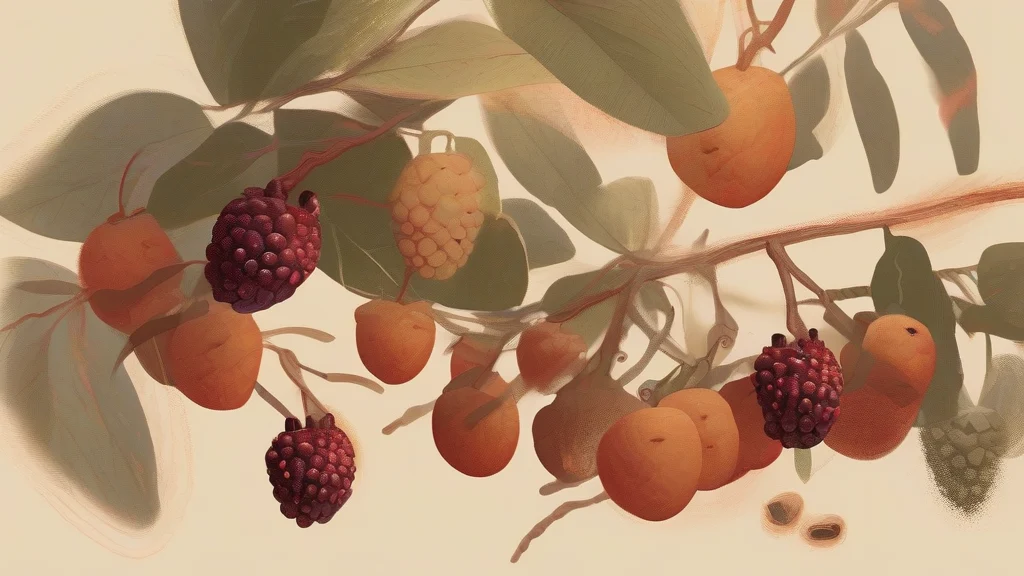
What does bacca mean?
Bacca is the Latin word for a berry, retained in modern English mainly as a technical term in botany and taxonomy. A bacca is a fleshy fruit produced from a single ovary, with one or more seeds embedded directly in the pulp — the structure botanists call a true berry, as seen in grapes, tomatoes, and currants. The word allows scientists to describe fruit anatomy precisely: many fruits colloquially called berries (such as strawberries or raspberries) are not baccae at all, while some structures like the juniper's fleshy cone are informally treated as one. Because of its classical origin, bacca carries a scholarly, slightly archaic flavour; ordinary readers will almost always encounter 'berry' instead. Its derived forms — baccate (resembling or bearing berries), baccivorous (feeding on berries), and bacciform (berry-shaped) — survive mostly in technical literature, making bacca a small but precise corner of the English lexicon borrowed straight from Latin.
nounA berry; in botany, a small pulpy fruit with seeds embedded in the flesh, produced from a single ovary.
- A berry, especially as a term of art in botany: a fleshy fruit formed from a single ovary with seeds embedded in the pulp.
"The juniper's dark blue bacca is actually a fleshy cone rather than a true fruit."
"The taxonomist described each bacca as globose and purplish-black at maturity."
"Junipers bear a distinctive blue bacca that is used to flavour gin."
General English typically uses 'baccas', while botanical and taxonomic writing often preserves the Latin plural 'baccae'.
"The branch bore several glossy black baccae."
Botanists still reach for the Latin word 'bacca' because some famous 'berries' — like the juniper's — turn out not to be berries at all.
Reviewed by Deb Chak, Editor. AI-assisted content curated by RJS Tech Solutions LLP.
Etymology of bacca
Bacca comes directly from Latin, where bacca meant 'berry'; the ultimate origin of the Latin word itself is uncertain, possibly connected to an earlier Mediterranean source. English adopted the word largely through scientific and botanical usage, where Latin terminology remained standard well into the modern era. It shares this root with the botanical adjectives baccate, baccivorous, and bacciform, which likewise derive from the same Latin noun.
How bacca is actually used
Bacca is chiefly a technical or scholarly term, encountered in botanical descriptions and scientific Latin rather than everyday speech, where 'berry' is used instead. When an anglicized plural is needed it is 'baccas', though botanical texts frequently retain the Latin plural 'baccae'.
Easily confused with bacca
Bucca is a Cornish folklore spirit or sea deity, whereas a bacca is a botanical berry.