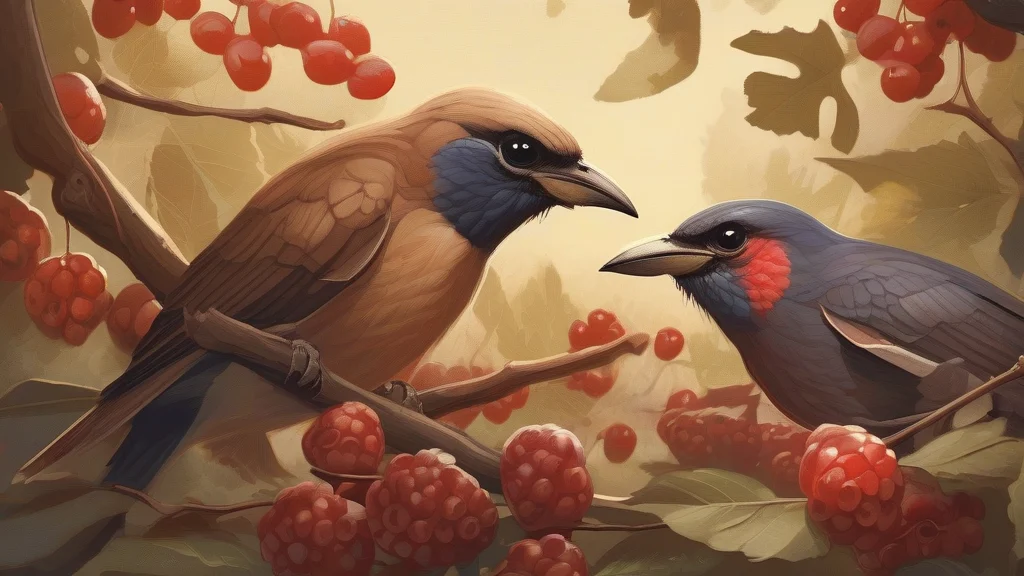
What does baccivorous mean?
Baccivorous is a rare adjective describing animals—most often birds—that feed on berries. Formed from the Latin 'bacca' (a berry) combined with '-vorous' (from Latin 'vorare', to devour), it belongs to the same family of diet-describing terms as carnivorous, herbivorous, and frugivorous, but with a narrower scope than frugivorous: where frugivorous covers fruit-eaters generally, baccivorous singles out berry specialists such as waxwings, blackbirds, and mistle thrushes. It appears almost exclusively in ornithological and ecological writing, where its precision is its virtue—a single word can characterise a species' seasonal reliance on hedgerow and forest berries. Though seldom encountered outside technical literature, it rewards writers seeking an exact, elegant term for nature's berry enthusiasts.
adjectiveFeeding on berries; berry-eating. The term is used chiefly in zoology and ornithology to describe animals—especially birds—whose diet consists largely or wholly of berries.
- Feeding on berries (used chiefly of birds and other animals).
"The waxwing is a famously baccivorous bird, stripping entire hedgerows of rowan berries in winter."
"Mistle thrushes are notably baccivorous, defending holly trees laden with red berries against all comers."
"In his monograph on woodland ecology, he catalogued the region's baccivorous fauna and the plants that sustained them."
While 'herbivore' and 'carnivore' are household words, the naturalists who needed a word for berry-mad birds like waxwings coined one of the most delightfully specific diets in English: baccivorous.
Reviewed by Deb Chak, Editor. AI-assisted content curated by RJS Tech Solutions LLP.
Etymology of baccivorous
The word derives from Latin 'bacca', meaning berry, joined to the suffix '-vorous', from the Latin verb 'vorare' ('to devour'), which also underlies carnivorous and herbivorous. Like its siblings in this dietary lexicon, baccivorous was coined by naturalists, probably during the nineteenth-century flourishing of descriptive zoology, when precise Latin-based terms for animal diets became fashionable. Its closest relative is frugivorous, which shares the '-vorous' element but takes 'frug-' from 'frux' or 'fructus' (fruit) instead.
How baccivorous is actually used
A rare, technical term found mainly in ornithological and zoological writing; it carries no strong connotation but lends an air of scientific precision.
Easily confused with baccivorous
Frugivorous describes eating fruit in general, while baccivorous refers specifically to feeding on berries.