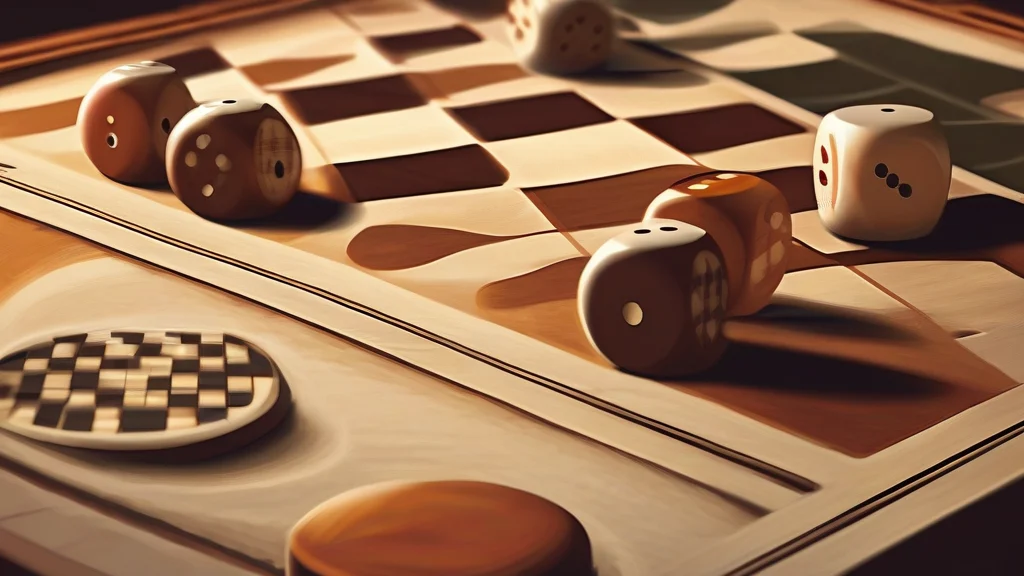
What does backgammon mean?
Backgammon is a classic two-player board game in which each player moves fifteen checkers around a twenty-four-point board according to the roll of dice, aiming to be the first to bring all their checkers home and off the board. Because dice introduce luck while strategy governs how those rolls are used, the game blends chance and skill, and doubling cubes allow players to raise the stakes mid-game. The word functions as an uncountable noun in modern English: one plays backgammon, owns a backgammon board or set, and speaks of a game of backgammon. Its tone is neutral, appearing equally in everyday conversation and literary prose. As a word, backgammon is notable for its transparent Old English roots — "back" plus "gamen," meaning game — and for naming what is often described as one of the oldest board games still played today, with archaeological evidence stretching back millennia across the ancient Near East.
nounA board game for two players in which checkers are moved around a board according to the roll of dice, the object being to bear all of one's checkers off the board first.
- The board game played by two players with dice and checkers, in which each player races to bear all their pieces off the board first.
- The board on which this game is played (as in "a backgammon").
"They played backgammon by the fire while the storm raged outside."
"My grandfather taught me to play backgammon when I was eight."
"The café kept a worn leather backgammon set behind the bar for regulars."
In practice, backgammon is treated as uncountable; speakers say "a game of backgammon" rather than pluralizing it, and the plural form appears only in very limited contexts such as scoring multiple victories.
"He won three backgammons in a row that evening."
Backgammon may be the oldest board game still widely played — sets nearly 5,000 years old have been unearthed in present-day Iran.
Reviewed by Deb Chak, Editor. AI-assisted content curated by RJS Tech Solutions LLP.
Etymology of backgammon
The word backgammon derives from Middle English, combining "back" with "gamen," the Old English word for game or sport, so it literally means "the game played on the back (of the board)." It was first attested in English in the early seventeenth century, though the game it names is far older, with ancestors known across the ancient world for thousands of years. The element "gamen" connects backgammon etymologically to the broader family of words descended from Old English "gamen," including "game" itself and, later, "gamble."
How backgammon is actually used
Used almost exclusively as an uncountable noun referring to the game itself; the plural "backgammons" exists technically but is rare and awkward. The register is neutral — the word appears comfortably in casual conversation, literature, and formal writing alike.
Easily confused with backgammon
"Gammon" refers both to cured ham and, in backgammon itself, a victory in which the loser has borne off no checkers — whereas "backgammon" names the board game as a whole.