
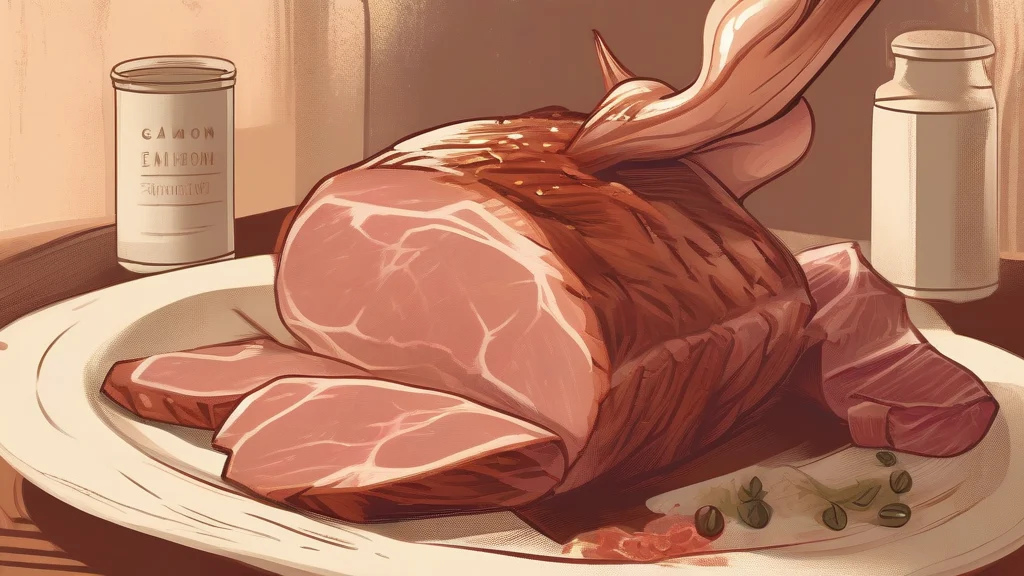
What does gammon mean?
Gammon is a cut of pork taken from the pig's hind leg and preserved by curing—typically by salting, brining, or smoking—in much the same way as ham. It is especially popular in Britain, where a whole 'gammon joint' is boiled or baked and served hot with parsley sauce or cold in slices, while thinner cuts are fried like bacon. The word carries a homely, traditional feel, evoking pub menus, Christmas leftovers, and country cooking. Beyond the kitchen, 'gammon' has two other distinct lives: in backgammon it names a decisive win scored when the losing player has borne off no pieces at all, worth double the usual stakes, and in contemporary British slang it jokingly describes the reddened complexion of someone worked up about politics—a usage so widespread it spawned the label 'gammon' for certain commentators. Few everyday words span the butcher's counter, the games table, and political satire quite so memorably.
A cured hind leg of pork, typically smoked or salted and cooked like ham.
"She served thick slices of gammon with eggs and chips."
In backgammon, a victory in which the defeated player has borne off no checkers, earning double points.
"The game ended in a gammon, doubling his score."
Informal British slang for the flushed, reddish complexion associated with an indignant or overwrought person.
"Online critics mocked the pundit as a prime example of gammon."
'Gammon' is usually treated as a mass noun when referring to the meat, so no plural is needed; the plural 'gammons' appears mainly when counting individual joints or, rarely, in gaming contexts.
"Two whole gammons were curing in the smokehouse."
The word 'gammon' comes from the same ancient root as 'jamb' — both trace back to 'leg,' because gammon literally is a pig's leg.
Reviewed by Deb Chak, Editor. AI-assisted content curated by RJS Tech Solutions LLP.
Etymology of gammon
Gammon entered English in the fifteenth century, borrowed from Old Northern French 'gambon,' meaning the leg or haunch of a pig. This derives from 'gambe' (leg), which itself traces back through Late Latin 'gamba' to Greek 'kampē,' originally referring to a bent leg or hock. The same Latin-Greek root gives English several other words connected to legs or bending, including 'jamb,' the vertical side of a doorway, and 'gambrel,' the term for both a horse's hock and the double-jointed roof style named after it.
How gammon is actually used
'Gammon' as a food term is chiefly British; Americans would more often say 'ham.' The slang sense describing a flushed face is recent, informal, and politically charged in British commentary, so use it with care.
Easily confused with gammon
Backgammon is the board game; 'gammon' there refers to a doubled victory within that game, whereas the noun 'gammon' on its own most commonly means the cured pork cut.