What does backpack mean?
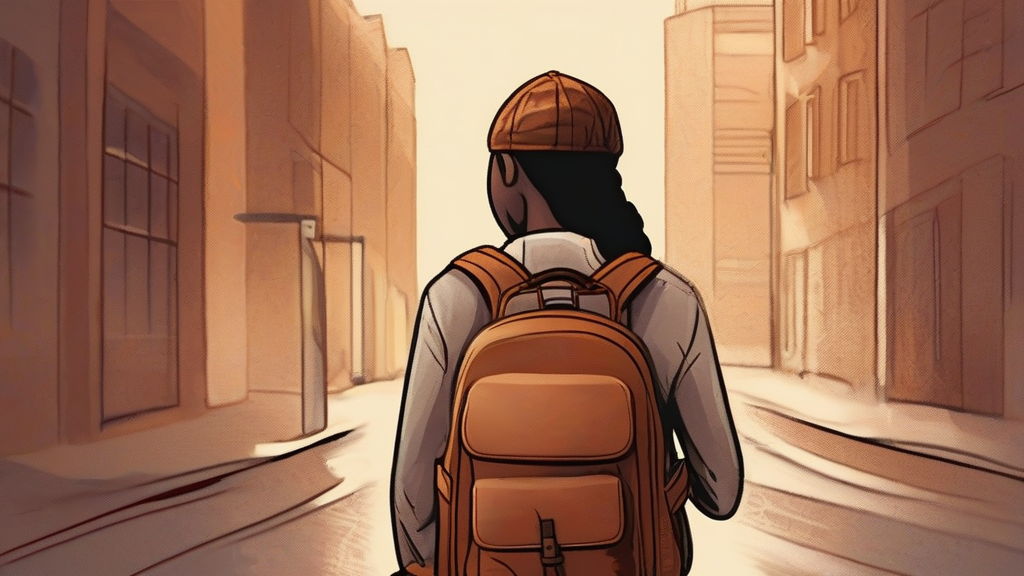
A backpack is a cloth or nylon bag fitted with two shoulder straps, designed to be carried on the back so that its weight rests on the shoulders and hips rather than the hands. It is the standard carrier for school books, commuter essentials, camping gear, and travelers' clothing, prized for leaving both hands free. In American usage 'backpack' has largely displaced older terms such as 'knapsack' and 'rucksack', though those words persist, especially in British English and military contexts. The word also functions as a verb: to backpack means to hike or travel while carrying all one's possessions in such a bag, giving rise to the nouns 'backpacker' and 'backpacking', which describe a style of budget-conscious, independent travel popular since the mid-twentieth century. Simple, practical, and universally recognized, 'backpack' is an essential word in modern English.
A bag supported by the shoulders with two straps, worn on the back for carrying belongings.
"My backpack holds my laptop, lunch, and gym clothes."
Preferred term in American English; British speakers often say 'rucksack' instead.
To hike or travel carrying one's equipment in a backpack.
"They backpacked across the Rockies for two weeks last summer."
Usually appears in the continuous forms 'backpacking' and 'backpacked'; strongly associated with hiking and budget travel.
Regular plural formation; used when referring to multiple bags, e.g. in retail, schools, or group hikes.
"All six hikers had heavy backpacks loaded with tents and food."
The word 'backpack' is barely a century old as a compound — before it caught on in early 20th-century America, English speakers made do with 'knapsack' and 'rucksack'.
Reviewed by Deb Chak, Editor. AI-assisted content curated by RJS Tech Solutions LLP.
Etymology of backpack
Backpack was coined in the United States in the early twentieth century as a straightforward compound of 'back' and 'pack', the latter being an ancient Germanic word denoting a bundle or load. It gradually displaced 'knapsack' (from Dutch via German) as the dominant American term during the twentieth century. The element 'pack' also gives us related words such as 'package', 'packet', and 'packhorse', all sharing the same root idea of something bundled for carrying.
Related word forms
How backpack is actually used
In American English, 'backpack' dominates everyday speech, while 'rucksack' is more common in British English. As a verb, 'to backpack' typically refers to low-cost independent travel or wilderness hiking, and its derivatives 'backpacker' and 'backpacking' are firmly established in travel vocabulary.
Easily confused with backpack
A rucksack is essentially the same type of bag — the term is the British and military-flavored equivalent of the American 'backpack', though some use it specifically for larger hiking packs with a top lid.