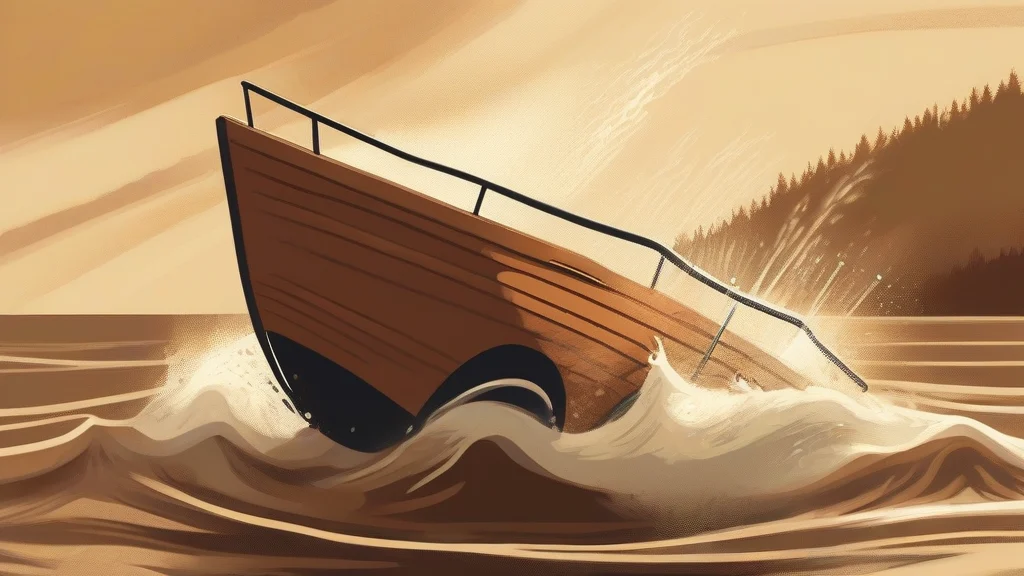
What does backwash mean?
Backwash is the backward flow of water, waves, or air created by the movement of an object through it — most familiarly the surge that rocks small boats after a ship or ferry passes, but equally the turbulence trailing behind an aircraft's wing or the rebounding current where waves strike a seawall. The word also has an established figurative sense: journalists and commentators use 'the backwash of' an event to describe its unwelcome aftermath, the residual disturbance left behind by a sudden decision or controversy. This dual character makes backwash unusually versatile for a technical term, linking the physical world of hydrodynamics with human affairs. Connotation matters: literally it is neutral, but figuratively it implies negative, disruptive consequences rather than neutral results. Compact and vivid, it lets writers describe both ripples on water and reverberations in politics with a single image.
A backward flow or surge of water, waves, or air generated by the passage or motion of a boat, aircraft, propeller, or other object.
"Anglers waited until the backwash from the passing barge had subsided before casting again."
Most common in nautical and aviation writing.
(Figurative) The unpleasant aftermath or chain of reactions following a dramatic event, decision, or controversy.
"The company is still dealing with the backwash of last year's data breach."
A backward-moving current in a river, channel, or shoreline where flowing water rebounds off an obstruction.
"Strong backwash below the weir makes swimming there dangerous."
Rarely pluralized; backwash usually refers to a specific, often singular, flow or episode, so writers typically treat it as countable-but-singular.
"The harbour master noted several dangerous backwashes near the breakwater that afternoon."
The same word that describes the wave rocking your canoe also describes the political fallout rocking a government — one term, two centuries of ripple effects.
Reviewed by Deb Chak, Editor. AI-assisted content curated by RJS Tech Solutions LLP.
Etymology of backwash
Backwash is formed from the compound of 'back', indicating reversal or return, and 'wash', the Old Norse-derived term (via Middle English) for the agitated water left by a moving vessel. The literal nautical sense arose naturally among English speakers describing the rearward surge behind ships, with the word well established by the nineteenth century. The figurative sense — a disturbing aftermath — developed later, extending the hydraulic metaphor to social and political affairs. Its sibling compounds such as 'backwater' and 'backlash' share the same pattern of 'back' joined to another root, reflecting English's fondness for such formations rather than descent from a single foreign ancestor.
How backwash is actually used
Primarily used in nautical, aviation, and hydrological contexts; the figurative sense ('the backwash of an event') appears mostly in journalism and formal commentary. It carries a mildly negative connotation when used figuratively, since it implies unwanted consequences. The word is countable and typically singular in reference to a specific flow or episode.
Easily confused with backwash
'Wash' refers to the disturbed water or air created by a moving object in general, while 'backwash' specifically denotes the backward-flowing portion of that disturbance — or figuratively, a negative aftermath.