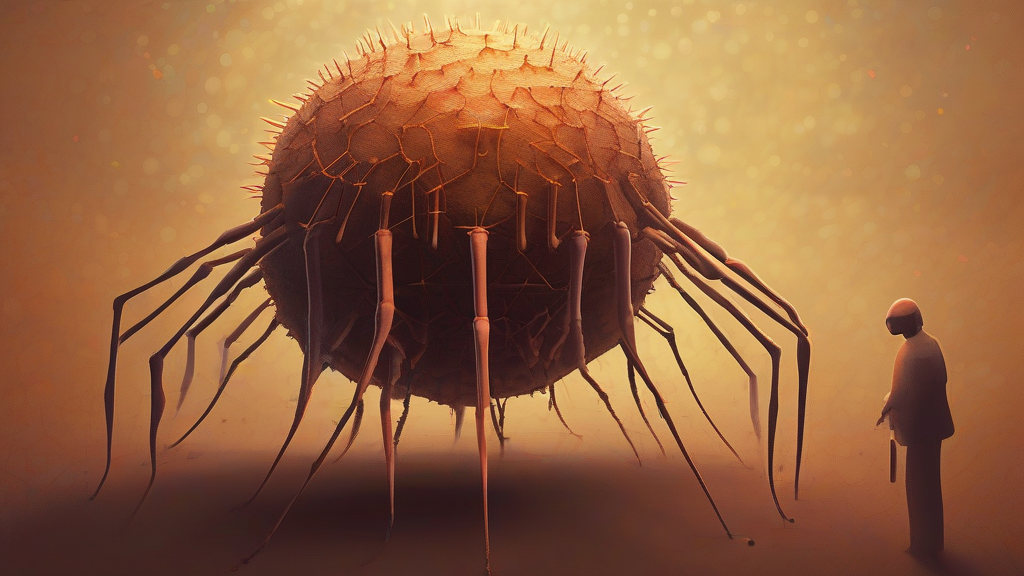
What does bacteriophage mean?
A bacteriophage, often simply called a phage, is a type of virus that infects bacteria. Like all viruses, it cannot reproduce on its own: it attaches to a bacterial cell, injects its genetic material, and hijacks the cell's machinery to produce new phage particles, typically destroying the host cell as they emerge. Bacteriophages are extraordinarily abundant — they are believed to be the most numerous biological entities on Earth, thriving in soil, oceans, and even the human body. First identified in the early twentieth century by Frederick Twort and Félix d'Hérelle, they were explored early on as treatments for bacterial infection, an approach known as phage therapy that has regained interest amid rising antibiotic resistance. Beyond medicine, bacteriophages became foundational tools in molecular biology: landmark experiments using them helped establish that DNA is the carrier of heredity. The term combines Greek roots for 'bacterium' and 'to eat', reflecting their bacteria-destroying nature.
nounA virus that infects and replicates within bacteria, often killing its bacterial host in the process. Bacteriophages are the most abundant biological entities on Earth and are important tools in molecular biology.
- A virus that infects bacteria and replicates inside them.
"The researchers used a bacteriophage to transfer new genetic material into the bacterial culture."
"Doctors at the clinic treated the antibiotic-resistant infection with an experimental cocktail of bacteriophages."
"Hershey and Chase used bacteriophages in their famous 1952 experiments confirming that DNA carries genetic information."
The standard English plural adds -s; the singular may refer either to one virus particle or to the species/type collectively depending on context.
"Sewage contains vast numbers of diverse bacteriophages."
There are an estimated 10^31 bacteriophages on Earth — more than every other organism combined, stacked end to end they would stretch past 100 million light-years.
Reviewed by Deb Chak, Editor. AI-assisted content curated by RJS Tech Solutions LLP.
Etymology of bacteriophage
The word bacteriophage derives from the Greek 'baktērion' (small staff or rod, referring to bacteria) combined with 'phagein' (to eat), coined to describe agents that consume bacteria. It was introduced around 1917 by French-Canadian microbiologist Félix d'Hérelle following his discovery of these bacteria-killing viruses, independently observed shortly beforehand by Frederick Twort in Britain. The suffix '-phage' also appears in related scientific terms such as phagocyte and macrophage.
How bacteriophage is actually used
Primarily a scientific and medical term, rarely encountered outside biology, medicine, and virology contexts; the shortened form 'phage' is common among specialists.
Easily confused with bacteriophage
Bacteria are living single-celled microorganisms, whereas bacteriophages are viruses that infect those bacteria.
A prophage is the dormant, integrated form of bacteriophage DNA within a host bacterium's genome, not an independent virus particle.