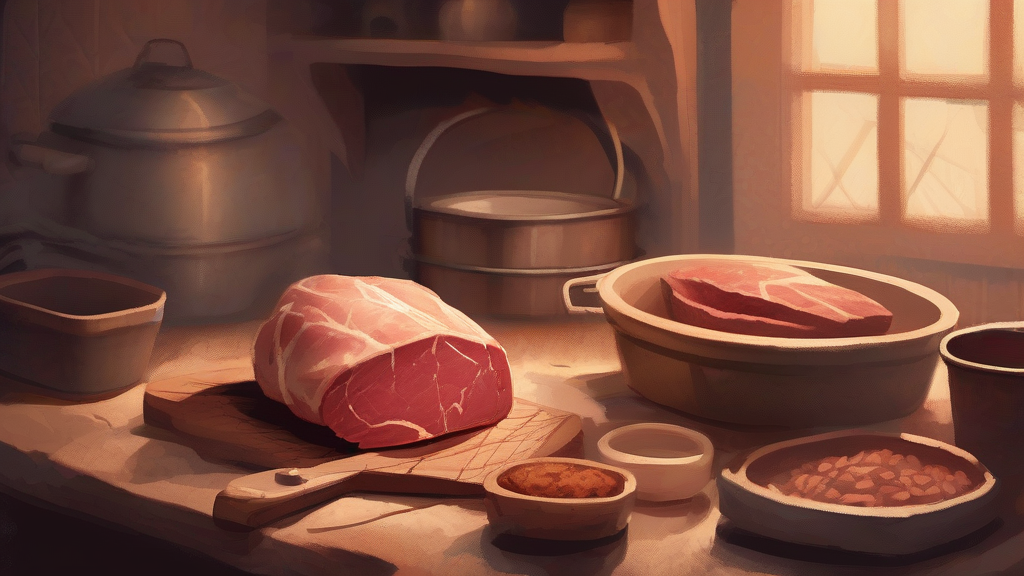
What does bakemeat mean?
Bakemeat is an archaic English noun denoting a dish of baked food, most often a pie or pasty filled with meat, though in its oldest usage the word could refer to any baked fare. Its survival today is largely confined to historical documents and the King James Bible, where it appears memorably in Genesis 27: instructed by Jacob to prepare a meal that will win his blind father's blessing, Rebekah makes 'savoury bakemeat' from two kids of the goats. The word is a compound of 'bake' and 'meat', but the second element carries the older sense of 'meat' as food of any kind rather than specifically animal flesh — the same sense preserved in 'sweetmeats' and 'mincemeat'. Because of this, modern readers sometimes misinterpret the word as implying meat in the contemporary sense, when it may simply describe baked provisions. Bakemeat offers an appealing window into how everyday English vocabulary has narrowed over four centuries, making it a favourite example in discussions of semantic change and early modern cooking.
nounAn archaic term for a dish of baked or cooked food, especially a pie or pasty containing meat; in older usage 'meat' meant simply 'food'. It survives chiefly in the King James Bible and other early modern texts.
- A dish of baked food, especially one consisting of meat enclosed in pastry (archaic).
- Baked food in general; food prepared by baking (obsolete, reflecting the old sense of 'meat' as simply 'food').
"In the King James account of Jacob and Esau, Rebekah prepares savoury bakemeat for Isaac."
"Go now to the flock, and fetch me from thence two good kids of the goats; and I will make them savoury bakemeat for thy father, such as he loveth."
"The medieval household records list bakemeat among the dishes served at the feast."
Rarely used; the plural appears occasionally in historical or culinary texts describing multiple baked dishes.
"The banquet table groaned under bakemeats of every description."
'Bakemeat' sounds like a butcher's error, but it's actually the word the King James Bible uses when Rebekah cooks to win Isaac's blessing — 'meat' once meant any food at all, not flesh.
Reviewed by Deb Chak, Editor. AI-assisted content curated by RJS Tech Solutions LLP.
Etymology of bakemeat
Bakemeat is formed from the verb 'bake', which derives from Old English 'bacan', combined with 'meat', which in Middle and Early Modern English meant 'food' generally rather than animal flesh specifically. The compound arose in the late medieval or early modern period and was well established by the time the King James translators rendered Genesis 27 with it in 1611. As 'meat' narrowed to mean only animal flesh, compounds like bakemeat fell out of ordinary use, surviving mainly in biblical and antiquarian contexts alongside kindred terms such as sweetmeat and mincemeat.
How bakemeat is actually used
Archaic and now encountered almost exclusively in historical or biblical contexts, particularly the King James Version (Genesis 27). The word reflects the earlier meaning of 'meat' as 'food' generally — a sense retained also in phrases like 'sweetmeats' and 'mincemeat'. Modern readers should not assume the dish necessarily contained flesh meat.
Easily confused with bakemeat
Mincemeat is a mixture of chopped fruit, suet, and spices (originally with meat), whereas bakemeat refers to the whole baked dish itself.