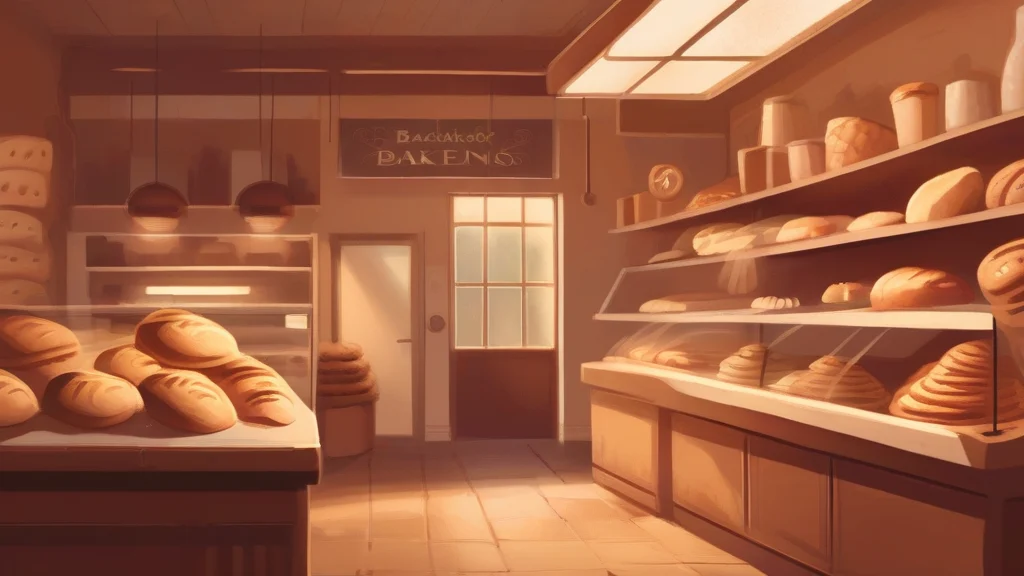
What does bakeshop mean?
A bakeshop is a retail establishment where baked goods — breads, cakes, cookies, pastries, and similar items — are prepared and sold to customers. Functionally synonymous with 'bakery', the term is especially common in North America, though it is understood throughout the English-speaking world. Many bakeshop owners emphasize that their products are made on the premises daily, and the word often evokes a warm, small-business atmosphere: the smell of fresh loaves, glass display cases of pastries, and early-morning queues. In everyday usage, a bakeshop may be a modest neighborhood counter or a larger commercial operation with seating. The word combines 'bake', from Old English 'bacan', meaning to cook by dry heat, with 'shop', denoting a place of trade. For writers and speakers, 'bakeshop' offers a slightly more colloquial or affectionate alternative to 'bakery', particularly when describing charming local establishments.
nounA shop where bread, cakes, pastries, and other baked goods are made and sold.
- A retail shop where baked goods such as bread, cakes, and pastries are produced and sold.
"She stopped at the corner bakeshop every morning for a fresh sourdough loaf."
"The aroma of cinnamon rolls wafted from the bakeshop on Main Street."
"He apprenticed at a Parisian bakeshop before opening his own patisserie."
Regular plural; used when referring to multiple such establishments.
"The city's oldest bakeshops line the historic waterfront district."
'Bakeshop' is essentially just a bakery with a different label — yet in North America it often signals that everything is baked fresh right there behind the counter.
Reviewed by Deb Chak, Editor. AI-assisted content curated by RJS Tech Solutions LLP.
Etymology of bakeshop
The word 'bakeshop' is a straightforward compound of 'bake' and 'shop'. 'Bake' descends from Old English 'bacan', meaning to cook by dry heat in an oven, a verb inherited from Proto-Germanic roots shared with Dutch 'bakken' and German 'backen'. 'Shop' comes from Old English 'sceoppa' or related Germanic sources, meaning a booth or stall for trade. The compound arose as an alternative to 'bakery' (which derives from 'bake' plus the suffix '-ery'), and both terms have coexisted since roughly the nineteenth century, with 'bakeshop' gaining particular traction in North American usage.
Related word forms
How bakeshop is actually used
Register is neutral; 'bakeshop' is slightly less formal than 'bakery' in some regions but is fully standard. It is more frequent in American and Canadian English; British English strongly prefers 'bakery'. The word often carries a cozy, artisanal connotation, suggesting small-scale, on-site production rather than mass manufacturing.
Easily confused with bakeshop
A bakery is the general term for a shop selling baked goods; 'bakeshop' is a common variant name for the same kind of establishment, often implying on-site baking.
A bookshop sells books, while a bakeshop sells bread and pastries — the two words rhyme and end in '-shop' but are unrelated in meaning.