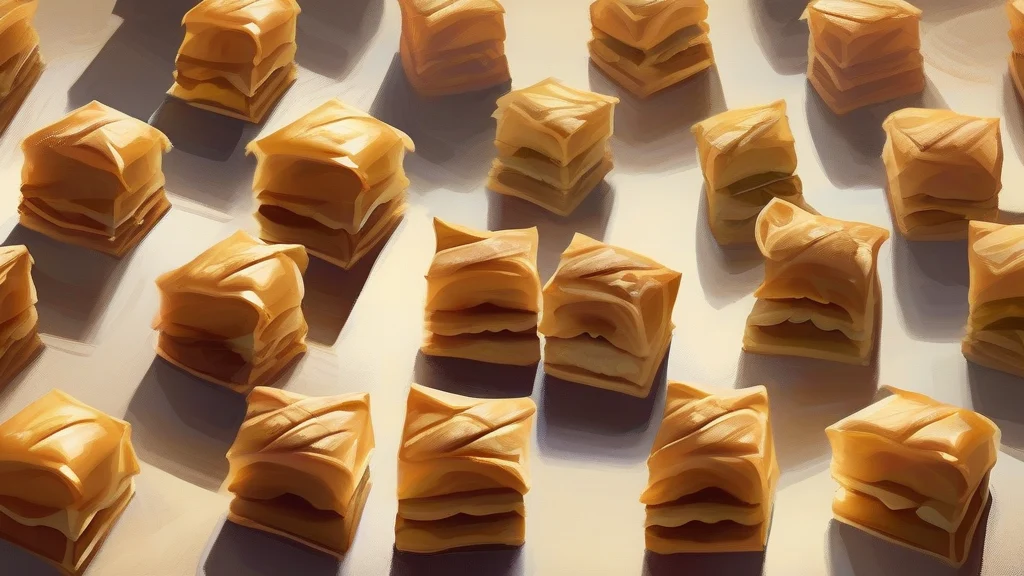
What does baklava mean?
Baklava is a rich, sweet pastry that stands among the most celebrated desserts of the Middle East, the Balkans, and the eastern Mediterranean. It is built from many paper-thin layers of filo dough brushed with butter and interleaved with finely chopped nuts — typically walnuts or pistachios — then baked and drenched in a fragrant syrup of honey, sugar, and often rosewater or orange blossom. The result is a dessert prized for its contrast of crisp, shattering pastry and dense, nutty sweetness. Baklava is commonly served in small diamonds or squares at celebrations, alongside coffee or tea, and is strongly associated with hospitality and festive occasions across Turkish, Greek, Arab, Persian, and Balkan culinary traditions. For English speakers it remains an exotic yet widely available treat, found everywhere from specialist bakeries to supermarket shelves.
nounA rich Middle Eastern and Mediterranean dessert made of thin layers of filo pastry filled with chopped nuts and sweetened with syrup or honey.
- A sweet layered pastry of filo dough, chopped nuts, and syrup or honey, associated especially with Turkish, Greek, and Middle Eastern cuisines.
"The bakery's baklava, glistening with honey and studded with pistachios, sold out before noon."
"She ended the meal with a small square of pistachio baklava and a cup of strong coffee."
"At the festival, vendors sold trays of baklava dripping with orange-blossom syrup."
Baklava is normally treated as a mass noun; a plural form appears only informally when referring to individual servings.
"The platter held a dozen golden baklavas dusted with crushed pistachios."
Debates over baklava's true homeland are so fierce that Greece and Turkey have both claimed it as a national treasure.
Reviewed by Deb Chak, Editor. AI-assisted content curated by RJS Tech Solutions LLP.
Etymology of baklava
Baklava entered English in the nineteenth century from Turkish, where the word has long been established for the layered nut-and-syrup pastry central to Ottoman cuisine. The deeper origins of the Turkish word are debated, with proposed links to Central Asian Turkic or Mongolian roots, so scholars generally describe its ultimate source as uncertain. What is clear is that the dessert itself was refined in the imperial kitchens of the Ottoman Empire and spread throughout the regions it influenced, giving rise to closely related pastries across Greek, Arab, and Balkan cooking.
How baklava is actually used
Baklava functions as a mass noun; it is usually referred to in pieces or portions rather than counted individually. It carries warm, indulgent connotations of celebration and hospitality.
Easily confused with baklava
Galaktoboureko is a Greek pastry filled with custard rather than nuts.