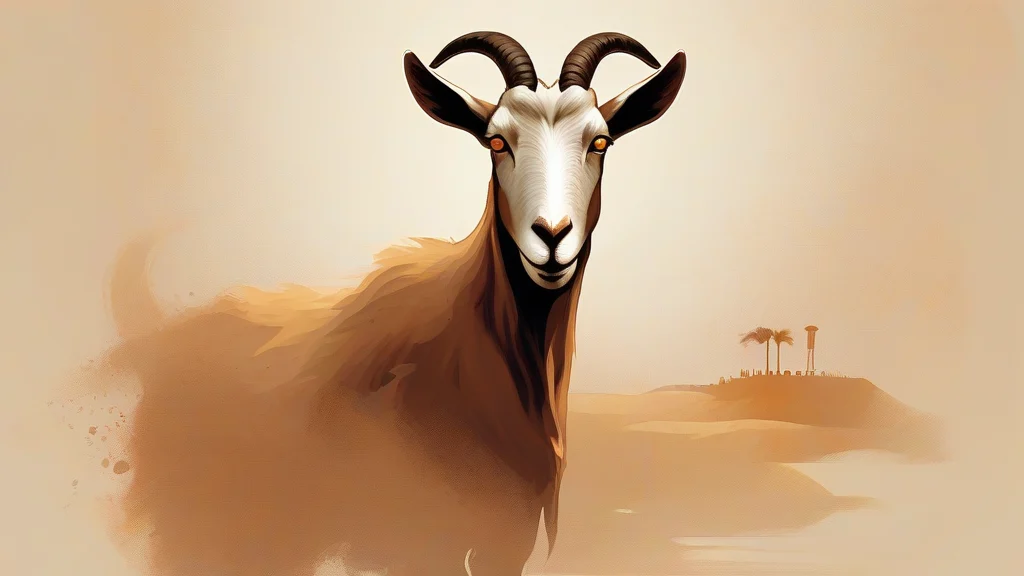
What does bakra mean?
Bakra is a noun borrowed into English from Hindi and Urdu, where it simply means a goat — most often a male goat. It is standard vocabulary throughout South Asia and among diaspora communities, appearing frequently in connection with Eid al-Adha, when goats are traditionally sacrificed, and with rural livestock markets. The word traveled with indentured laborers to the Caribbean, where in Trinidadian and other West Indian English it took on a figurative life: to be 'the bakra' is to be the butt of a joke, the dupe, or the one who bears the blame. This dual identity — a literal farm animal in one part of the world and a slang term for a hapless victim in another — makes bakra a vivid example of how words migrate and shift meaning. Outside these regions it remains unfamiliar to most English speakers, so writers typically gloss it on first use.
nounA goat, especially a male goat; the word is borrowed from Hindi/Urdu and is used in South Asian English and, by extension, in Caribbean English.
- A goat, especially a male goat (borrowed from Hindi/Urdu).
- In Caribbean English, a person who is fooled, victimized, or used as a scapegoat.
"For Eid al-Adha, the family purchased a bakra from the livestock market on the edge of town."
"The children fed the bakra grass behind the house until the festival morning arrived."
"In Trinidadian speech, anyone who falls for an April Fool's trick is teased as 'the bakra.'"
Because bakra is a loanword, English speakers usually either use the inherited plural bakre or revert to 'goats' rather than anglicizing it as 'bakras,' though the latter does occur informally.
"Several bakre were tethered outside the mosque before the festival."
In Caribbean slang, calling someone 'the bakra' can mean they've been made the fool of the joke — but in Hindi, bakra literally means the goat that might end up at the feast.
Reviewed by Deb Chak, Editor. AI-assisted content curated by RJS Tech Solutions LLP.
Etymology of bakra
Bakra comes directly from Hindi and Urdu, in which it denotes a he-goat; it entered English through colonial-era contact with South Asia and, separately, through the migration of Indian indentured laborers to the Caribbean in the nineteenth century, whose descendants preserved the word in local English. Its figurative use in Caribbean English — a person who is fooled or sacrificed metaphorically — grew naturally out of the animal's association with ritual slaughter.
How bakra is actually used
The word is informal and regionally specific: it is everyday vocabulary across India, Pakistan, and Bangladesh, and survives as a loanword in the English of the Caribbean, where its figurative sense developed. In standard British or American English it would appear only in contexts dealing with South Asian culture.
Easily confused with bakra
A backer is someone who provides financial support to a venture, whereas a bakra is a goat or, figuratively, a person who is duped or made a scapegoat.