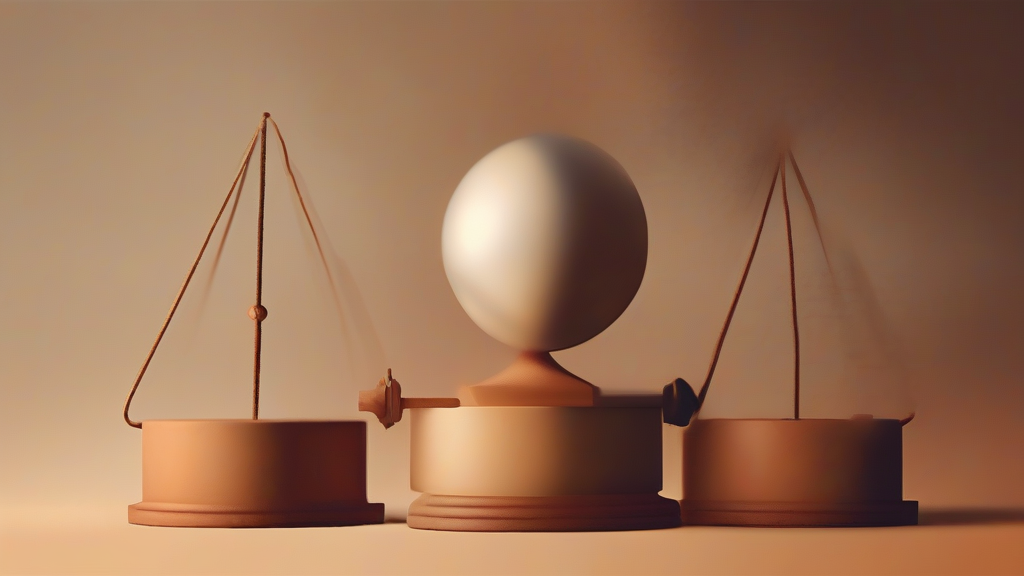
What does balance mean?
Balance refers to a state of equilibrium — an even distribution of weight or force that keeps something steady, whether that thing is a body standing upright, a set of competing priorities, or the columns of an account book. As a noun, balance covers a wide range of contexts: physical poise, fairness between opposing elements, emotional composure, the money remaining in a bank account, and the traditional two-pan weighing device known as a pair of scales. Its verb forms extend these ideas, meaning both to remain steady and to weigh competing factors against each other. Because so many domains — finance, physics, ethics, diet, design — rely on the idea of things being properly proportioned, 'balance' is among the most widely applicable words in English. It carries broadly positive connotations, suggesting harmony, moderation, and good judgment, and appears in common expressions such as 'strike a balance' and 'off balance'.
An even distribution of weight or force that enables steadiness; a condition of equality or correct proportion among differing elements; the amount of money remaining in an account; or an instrument consisting of a beam with two pans for weighing.
"She adjusted the load until the pallet truck sat perfectly in balance."
In accounting, 'balance' specifically denotes the net figure after summing credits and debits.
To keep or put something in a steady position, or to offset or compare two things so that neither outweighs the other.
"He balanced the checkbook carefully before paying the invoice."
Describing a state or arrangement that is evenly proportioned, stable, or impartial, as in 'a balanced diet' or 'a balanced report.'
"The article offered a balanced view of the controversial policy."
Used when referring to multiple accounts, scales, or instances of equilibrium, most commonly in financial contexts.
"The report listed balances across all four regional accounts."
The word 'balance' comes from Latin 'bilanx', meaning 'having two scales' — literally two pans hanging from a single beam.
Reviewed by Deb Chak, Editor. AI-assisted content curated by RJS Tech Solutions LLP.
Etymology of balance
Balance derives from Latin 'bilanx', meaning 'having two scales' or 'two pans', formed from 'bi-' (twice) and 'lanx' (dish or pan of a scale). The word passed through Old French 'balance' before entering Middle English around the late thirteenth century, initially referring to the weighing instrument. Over time its meaning broadened figuratively to describe any state of equilibrium or fair proportion, and cognates such as French 'balance' and Spanish 'balanza' preserve the same Latin root.
Related word forms
How balance is actually used
'Balance' spans both concrete physical senses (steadiness, scales) and abstract ones (fairness, financial totals). In everyday speech, phrases like 'work-life balance' carry positive connotations of health and moderation. The verb form 'to balance' means both to keep steady and to compare competing priorities.
Easily confused with balance
Ballast is heavy material used to stabilize a ship or structure, while balance is the state of equilibrium itself.