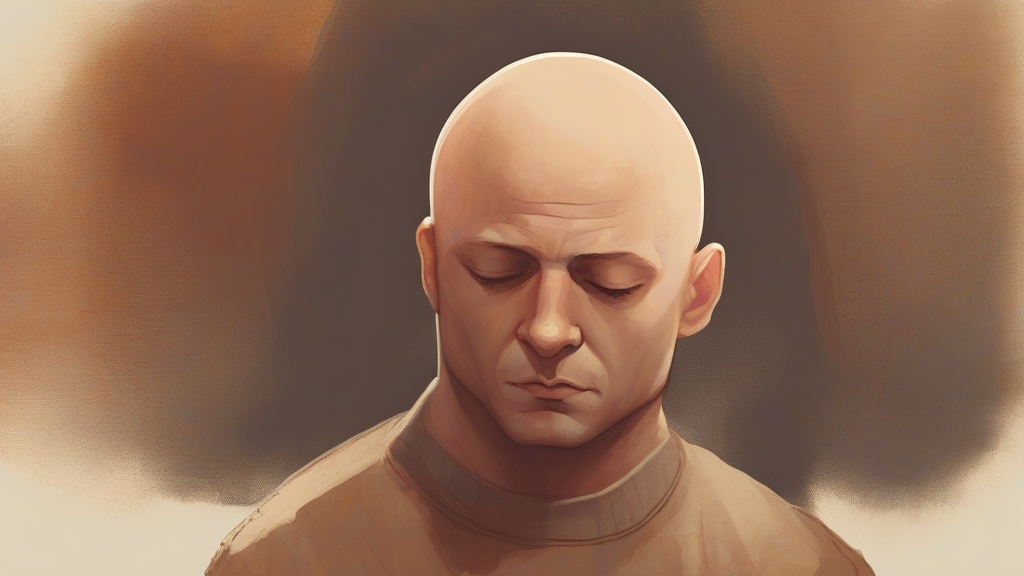
What does baldheaded mean?
Baldheaded is an adjective describing someone who has no hair on the scalp — a person who is entirely bald. It is a more emphatic and somewhat blunter term than simply 'bald', combining the words 'bald' and 'headed' into a single descriptive compound, and it appears most often in everyday, informal speech. The word also carries a secondary, largely American figurative sense: to do something 'baldheaded' means to charge into it boldly and recklessly, without hesitation or any effort to disguise one's intentions, as in 'he went baldheaded after the deal'. In this usage the phrase survives mostly in fixed expressions such as 'go baldheaded' or 'walk in baldheaded'. Because it can be confused with 'bareheaded' — which merely means wearing no hat while still having hair — precision matters. Baldheaded remains useful as a vivid, direct descriptor of complete hairlessness.
Having no hair on the scalp; completely bald.
"A tall, baldheaded man greeted us at the door."
Neutral to slightly blunt in tone; common in informal speech.
(Of an action) done boldly and rashly, without hesitation or attempt at concealment.
"She went baldheaded into the argument, stating her demands outright."
Chiefly American; now mostly confined to set phrases such as 'go baldheaded'.
"To go baldheaded" once meant charging into something with reckless abandon — proof that this word is about nerve as much as it is about hair.
Reviewed by Deb Chak, Editor. AI-assisted content curated by RJS Tech Solutions LLP.
Etymology of baldheaded
Baldheaded is a straightforward English compound formed from 'bald' and 'headed', both long established in the language. 'Bald' derives from Middle English 'ballede', first recorded around the thirteenth century, of uncertain ultimate origin, possibly related to a Celtic word for a white patch on the head of an animal. 'Headed' comes from Old English 'hēafod', meaning head, combined with the adjectival suffix '-ed'. The compound arose in English by the seventeenth century, and its figurative sense — acting boldly and recklessly — developed from the image of advancing openly, without cover or concealment.
Related word forms
How baldheaded is actually used
Mostly informal to neutral in register; the literal sense often carries no strong connotation beyond simple description, though it can sound blunt. The figurative sense ('boldly, rashly') is chiefly American and less common today, surviving mainly in set phrases such as 'go baldheaded' or 'walk in baldheaded'.
Easily confused with baldheaded
Bareheaded means not wearing a hat or other head covering (the hair may still be present), whereas baldheaded means having no hair on the scalp at all.
Boldfaced describes shameless impudence or audacity, while baldheaded describes either literal baldness or acting recklessly without hesitation.