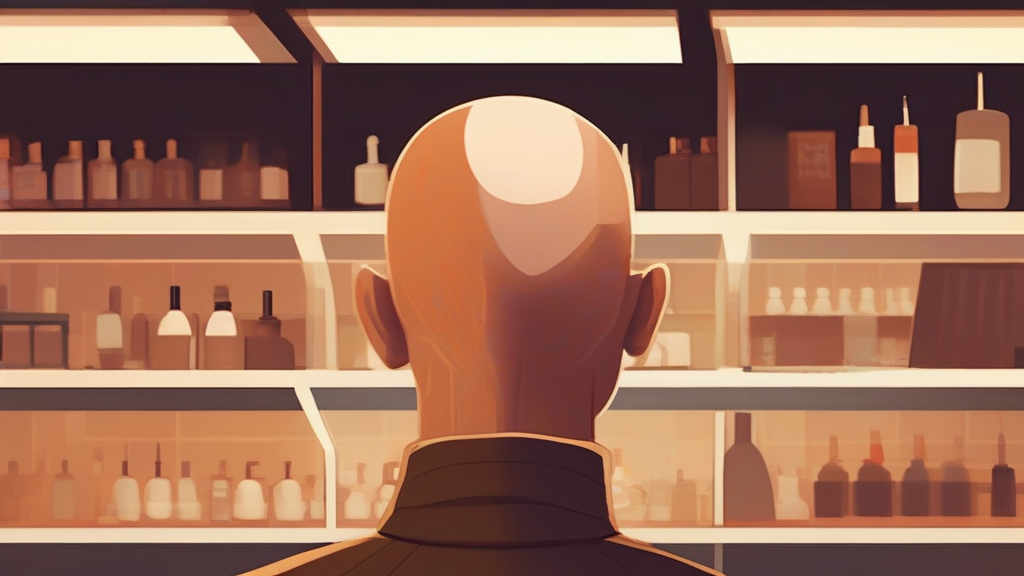
What does bald mean?
Bald is an adjective describing the absence of hair, most commonly on the human scalp, though it can apply to any part of the body or to animals. Beyond its literal sense, it carries a well-established figurative meaning: something described as bald — a statement, an account, a fact — is presented plainly, without embellishment or attempt to soften it. A third practical use applies to tires whose tread has worn smooth. The word's connotations vary with context: literal baldness is generally neutral today and widely accepted, even fashionable, but calling attention to someone's hair loss can seem tactless, which is why softer phrasing like 'thin on top' often substitutes in conversation. Its most famous compound is the bald eagle, the national bird of the United States, named not for hairlessness but for its distinctive white-feathered head — an older sense of the word meaning white or pale-patched. Bald remains a compact, versatile word bridging physical description, frank expression, and everyday wear.
Having no hair on all or part of the scalp; hairless.
"Her grandfather has been bald since his forties."
(Of tires or surfaces) worn smooth; lacking tread or texture.
"The car failed inspection because its tires were bald."
Plain, blunt, or lacking embellishment or detail.
"He stated the bald truth: the company was insolvent."
The bald eagle isn't bald at all — its name comes from an old sense of 'bald' meaning 'white-marked', from the bird's snowy white head.
Reviewed by Deb Chak, Editor. AI-assisted content curated by RJS Tech Solutions LLP.
Etymology of bald
Bald derives from Middle English 'ballede', formed around the 14th century, likely combining 'ball' (a rounded, smooth mass) with the suffix '-ed', giving the sense of a smooth or shining head. It is related to other Germanic words denoting round or smooth shapes, and some scholars connect it further to Old English and Proto-Germanic roots for 'round object'. By the 17th century the extended senses had developed: 'plain or unadorned' by the late 16th–early 17th century, and the application to birds with white heads — preserved in the name 'bald eagle' — reflects an older meaning of the word referring to white markings.
Related word forms
How bald is actually used
Neutral to slightly sensitive in register: describing someone as 'going bald' can feel pointed, so speakers often prefer euphemisms like 'thinning' or 'losing his hair'. The figurative sense ('the bald truth', 'a bald statement') is common in formal writing and journalism. In informal British English, the simile 'as bald as a coot' is well established.
Easily confused with bald
'Bald' means lacking hair (or plain/unadorned), while 'bold' means brave, confident, or daring.
A 'ballad' is a narrative song or poem; 'bald' describes an absence of hair or ornamentation.