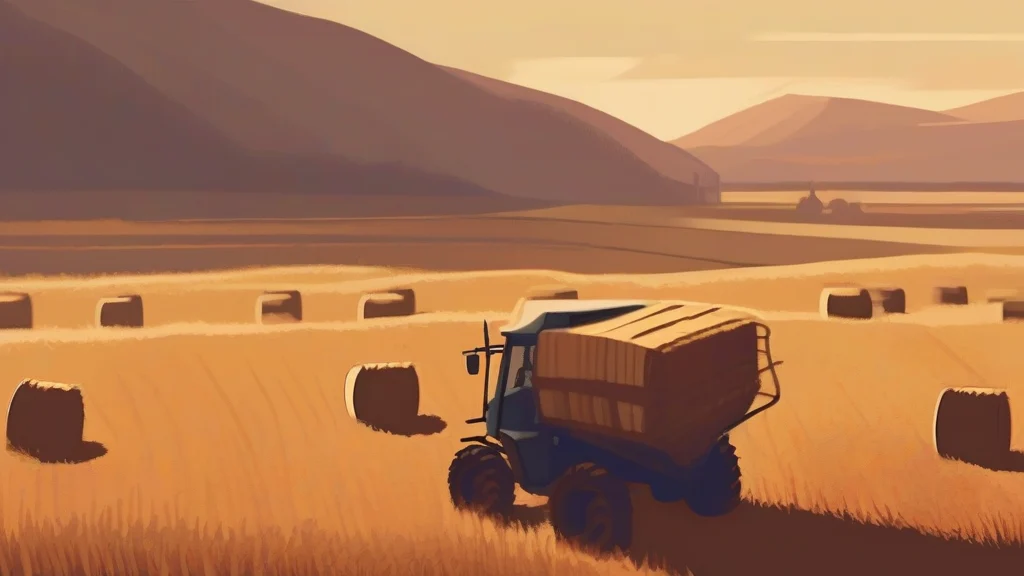
What does baler mean?
A baler is a machine — or, less commonly today, a person — that compresses loose material such as hay, straw, cotton, cardboard, or recyclable waste into tightly packed bundles called bales. On farms, balers are indispensable: they gather windrowed hay or straw from the field and form it into either cylindrical 'round' bales or rectangular 'square' bales, which are far easier to lift, stack, transport, and store than loose material. Industrial balers perform the same essential task in recycling facilities and warehouses, compressing cardboard, plastics, and scrap metal to reduce volume and cut handling costs. The word derives from 'bale', the bundle itself, which traces back through Middle English to Old French. Practical and unglamorous, 'baler' carries no particular emotional connotation; it is simply a workaday term central to agriculture, logistics, and waste management. Its everyday importance makes it a useful word for anyone reading about farming, machinery, or recycling.
nounA machine that compresses cut hay, straw, or other material into compact bales for easier handling, storage, and transport; also, a person who bales material such as hay or cotton.
- A machine that compresses cut hay, straw, paper, cardboard, or other material into dense, manageable bales.
- A person whose job is to bale material such as hay or cotton.
"The farmer spent the afternoon repairing the baler before the rain arrived."
"The round baler rolled through the field, leaving a trail of neatly wrapped bales behind it."
"At the recycling centre, staff feed flattened cardboard into an industrial baler to save storage space."
Standard plural, used for both the machine and the rarer human sense.
"The farm co-op owns three balers, all kept busy through the summer harvest."
Without the humble baler, modern farming would still be hauling loose hay by the wagonload — the machine's compressed bales turned a backbreaking chore into a one-person job.
Reviewed by Deb Chak, Editor. AI-assisted content curated by RJS Tech Solutions LLP.
Etymology of baler
The word 'baler' is formed from 'bale', meaning a large bound bundle of goods, combined with the agentive suffix '-er'. The noun 'bale' entered Middle English from Old French 'bale', likely of Germanic origin. As machinery transformed agriculture during the nineteenth century, 'baler' came to denote the machines that mechanised the age-old task of bundling hay and straw, and later extended to industrial presses used on cardboard and recyclables.
Related word forms
How baler is actually used
In agricultural contexts, 'baler' almost always refers to farm machinery, with distinctions drawn between round balers and square (rectangular) balers. In industrial and recycling contexts, it denotes equipment for compressing cardboard, plastic, or metal. The human sense is now rare and largely historical.
Easily confused with baler
A bailor is someone who entrusts goods to another under a legal bailment arrangement, whereas a baler is a machine or person that packs hay, straw, or similar material into bales.