What does bale mean?
A bale is a large, tightly bound bundle of compressible material — most familiarly hay, straw, or cotton, but also wool, paper, cardboard, or recycled plastics — pressed together and secured with twine, wire, or strapping so that loose bulk becomes a unit of manageable size and weight. The word functions both as a noun and, less commonly, as a verb meaning to form material into bales, giving rise to terms like "baler," the machine that does the work. Bales are central to agriculture and commerce because they make transport, stacking, and storage vastly more efficient; standardised sizes even allow machinery to handle them automatically. In figurative use the word appears little, though its homophone "bail" causes frequent spelling confusion. Rooted in medieval trade vocabulary via Old French, "bale" remains a practical, workaday word whose importance lies in the sheer volume of global goods moved in this humble bundled form.
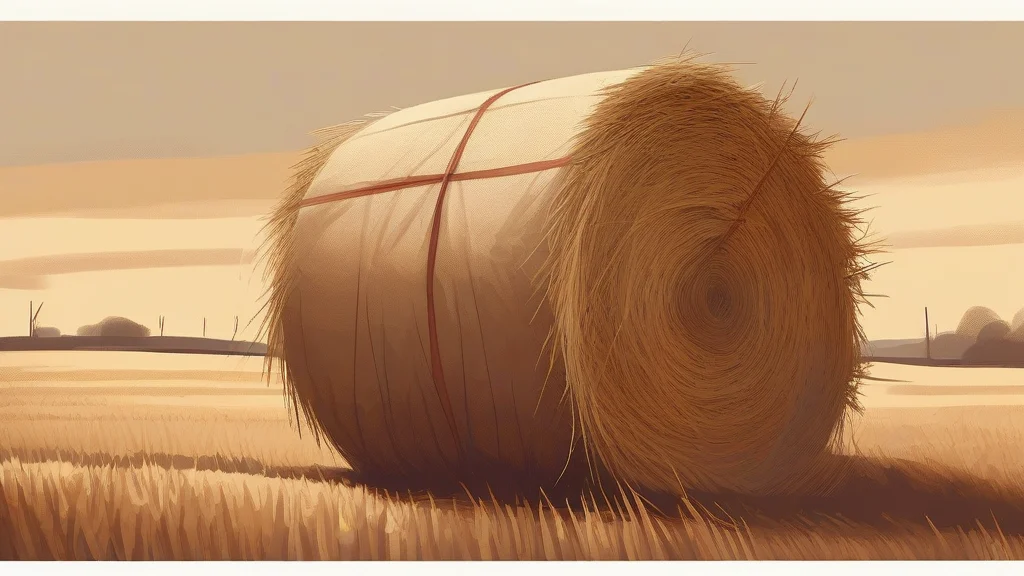
A large bound bundle of compressed material such as hay, straw, cotton, or paper, prepared for storage or transport.
"Each bale of hay weighed nearly half a tonne."
To compress and bind material into bales.
"The crew spent all day baling the harvested straw."
Usually encountered in progressive forms such as "baling" or as the past participle "baled".
Regular plural; commonly used with partitive constructions such as "two bales of hay".
"The barn held forty bales of straw."
A single bale of hay can weigh over half a tonne — yet farmers still toss them around like feather pillows when they're feeling strong.
Reviewed by Deb Chak, Editor. AI-assisted content curated by RJS Tech Solutions LLP.
Etymology of bale
The word "bale" entered Middle English from Old French "bale", denoting a packed load of merchandise, and is generally traced back to a Germanic root also reflected in words like "ball", suggesting an original notion of something rounded or bundled. It was used in commercial English by the late medieval period for consignments of cloth and other goods shipped in packed bundles. A separate, unrelated Middle English word "bale" meaning misery or evil derives from Old English "bealu" and survives only in derivatives such as "baleful".
Related word forms
How bale is actually used
"Bale" is primarily an agricultural and commercial term, common in farming and freight contexts. As a verb it usually appears in the continuous form "baling" in everyday speech. It should not be confused with "bale" meaning sorrow or evil, an older and largely archaic sense that survives chiefly in the derivative "baleful."
Easily confused with bale
"Bail" refers to security deposited to free a prisoner or a bucket-like tool, while "bale" is a large bundled mass of goods such as hay or cotton.