What does balti mean?
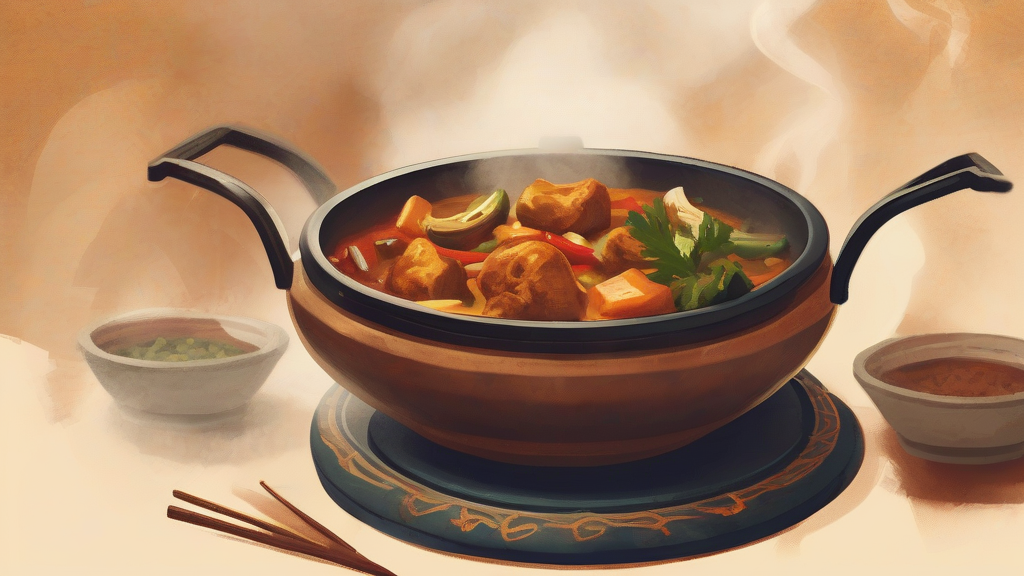
A balti is a style of curry that emerged in Birmingham, England, during the 1970s, developed by the city's South Asian community rather than imported directly from the Indian subcontinent. The word denotes both the meal itself — a medium-spiced, quickly cooked curry, often made with chicken, lamb, or vegetables in a tomato-based sauce — and the distinctive shallow, round-bottomed steel or cast-iron pan, fitted with two loop handles, in which it is cooked and served. Balti became so embedded in local culture that an area of south Birmingham packed with such restaurants earned the nickname the 'Balti Triangle', and the term now appears on menus across Britain and beyond. Etymologically, the name likely derives from the Hindi-Urdu word for a bucket or pail, itself borrowed from Portuguese, though some argue it references Baltistan. Casual in register but firmly established in British food vocabulary, 'balti' is a useful term for anyone describing Anglo-Asian cuisine.
nounA style of curry cooked and served in a thin steel or iron wok-like dish known as a balti bowl; also the dish itself. The cuisine originated among Birmingham's South Asian community in England.
- A curry dish of South Asian origin cooked and served in a balti pan, associated especially with Birmingham's 'Balti Triangle'
- The shallow, two-handled steel or cast-iron pan in which such food is cooked and served
"We ordered a chicken balti with naan bread at the new restaurant on Curry Mile."
"The Balti Triangle in Sparkbrook is famous for its dozens of family-run balti houses."
"She simmered the lamb balti in a carbon-steel pan until the sauce clung to the meat."
Standard pluralisation applies when referring to multiple dishes or pans.
"The menu offered several different baltis, each served sizzling in its own pan."
Balti isn't Indian, Pakistani, or Bangladeshi cuisine — it was invented in Birmingham, England, in the 1970s, making one of Britain's favourite curries a genuinely Brummie creation.
Reviewed by Deb Chak, Editor. AI-assisted content curated by RJS Tech Solutions LLP.
Etymology of balti
Balti most likely derives from Hindi-Urdu 'baltī' meaning bucket or pail, which in turn traces back through Portuguese 'balde' during colonial contact, reflecting the shape of the cooking vessel. The dish itself was created in Birmingham, England, in the 1970s by South Asian restaurateurs, giving rise to the famous 'Balti Triangle' district. Some sources alternatively link the name to the Baltistan region of Pakistan, though this is contested.
How balti is actually used
Register is casual/food-related. In British usage, 'a balti' can mean both the meal and the vessel, which sometimes confuses non-British speakers. Often ordered 'balti-style'. Not typically used formally outside culinary contexts.
Easily confused with balti
Bhuna is a dry, slowly fried curry style, whereas a balti is a quickly cooked curry served in a two-handled steel wok.
Karahi refers to a similar South Asian wok-like cooking vessel and the curries cooked in it; balti specifically denotes the Birmingham-developed Anglo-Indian variant.