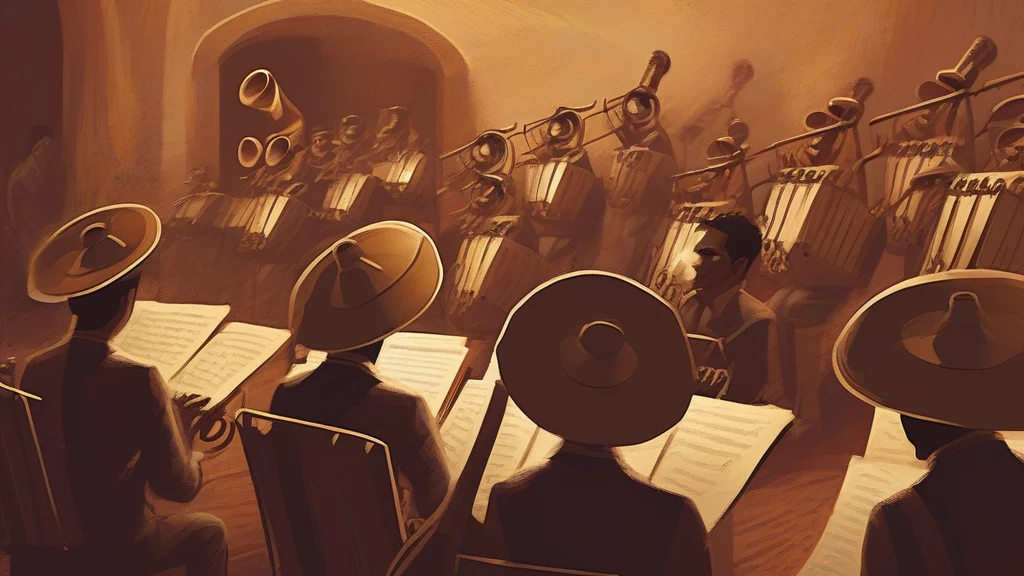
What does banda mean?
Banda is a vibrant genre of Mexican popular music performed by large ensembles built around brass and percussion — typically tubas, trombones, trumpets, clarinets, tarolas, and the deep bass drum known as tambora. Emerging in the state of Sinaloa in the late nineteenth century, it drew on military band traditions and Central European dances such as polkas and waltzes introduced by German and Czech immigrants, fusing them with Mexican song forms. The result is a brassy, high-energy sound equally at home at weddings, quinceañeras, and festivals. In English, 'banda' names both the music itself and the ensemble that plays it, appearing most often in North American writing about regional Mexican music alongside related styles like norteño and mariachi. A modern offshoot, technobanda, added electronic keyboards and found a huge audience among Mexican-American communities in California during the 1980s and 1990s.
nounA genre of Mexican popular music performed by large ensembles of brass instruments, woodwinds, and percussion, typically featuring tuba, trombones, clarinets, and a prominent drum; by extension, such an ensemble itself.
- The Mexican musical genre built on brass, woodwind, and percussion ensembles.
- A specific ensemble (the band itself) that performs this style.
"The wedding reception erupted into dancing when the banda struck up its first polka."
"Her uncle plays tuba in a local banda that performs at every town festival."
"Technobanda swept Los Angeles dance halls in the 1990s, blending traditional banda arrangements with electronic keyboards."
Regular pluralization; the anglicized form 'bandas' is standard in English writing.
"Several bandas competed at the festival's opening night."
Born from military bands and German polkas that reached Mexico in the 19th century, banda turned imported brass into one of the loudest, proudest sounds in Latin music.
Reviewed by Deb Chak, Editor. AI-assisted content curated by RJS Tech Solutions LLP.
Etymology of banda
The word 'banda' entered English from Mexican Spanish, where it means simply a band or musical group. Spanish 'banda' itself derives from a Romance term for a company of people or a body of men, a root it shares with English 'band'; the precise deeper origin of this family of words is debated, though Germanic sources have often been proposed. The term became attached specifically to the brass-band tradition that took shape in Sinaloa, Mexico, in the nineteenth century, and was adopted into English as that music spread north into the United States.
How banda is actually used
In English-language contexts 'banda' appears mainly in discussions of Mexican and regional-Mexican-American music; it carries no negative connotation and sits comfortably alongside terms like norteño and duranguense when describing the regional genres of northern and western Mexico.
Easily confused with banda
'Band' is the general English word for any musical group, while 'banda' specifically denotes the Mexican brass-and-percussion tradition and its ensembles.