What does bandicoot mean?
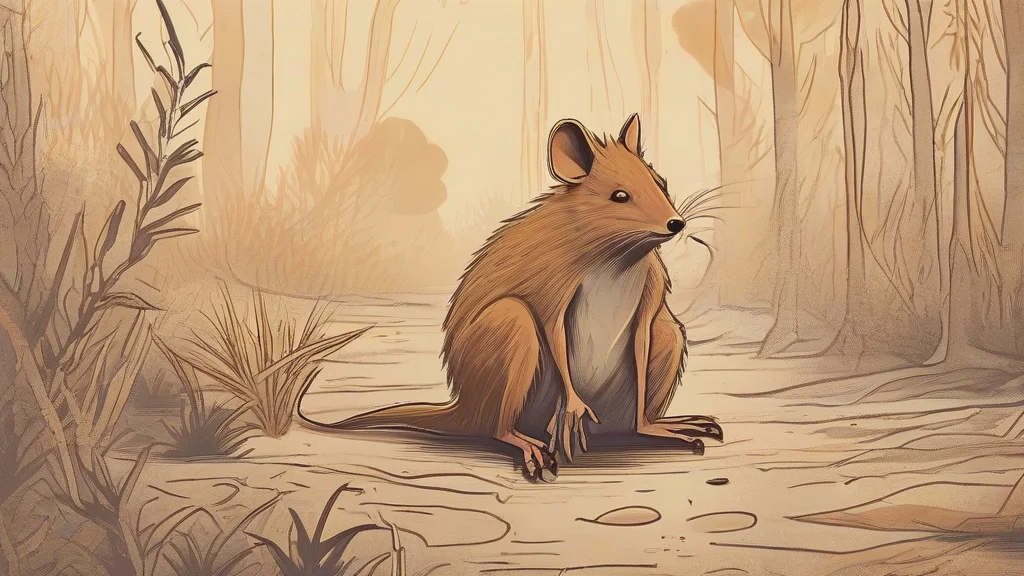
A bandicoot is a small to medium-sized marsupial mammal native to Australia and New Guinea, recognized by its pointed snout, hunched back, and compact, rounded body. Nocturnal and largely solitary, bandicoots dig conical holes in soil as they forage for insects, larvae, roots, and fungi, making them frequent visitors — and sometimes minor nuisances — in suburban gardens. The name also refers to the bandicoot rats of southern Asia, large rodents of the genus Bandicota, which share little beyond the borrowed name. The word itself has a remarkable history: English adopted it from the Telugu language of southern India, where it described a pig-like rat, before naturalists applied it to the unrelated Australian marsupials. Several bandicoot species are threatened or endangered, so the word carries strong associations with conservation in Australia. For readers interested in natural history, 'bandicoot' offers a vivid example of how a single name can migrate across continents and animals.
nounA small to medium-sized nocturnal marsupial native to Australia and New Guinea, with a pointed snout and compact body, that digs for insects, roots, and fungi. The name is also applied to certain large rats of South Asia (bandicoot rats) of the genus Bandicota.
- Any of various small to medium-sized insectivorous or omnivorous burrowing marsupials of the family Peramelidae, native to Australia and New Guinea.
- A large rat of the genus Bandicota of southern Asia, commonly known as a bandicoot rat.
"A bandicoot snuffled through the leaf litter at the edge of the garden, searching for grubs."
"At dusk the eastern barred bandicoot emerges to dig for beetle larvae in the soft soil."
"In parts of India, a bandicoot rat can grow larger than a domestic cat."
Standard pluralization applies; there is no irregular plural form.
"Bandicoots once ranged widely across the Australian mainland, though several species are now confined to small populations."
The word 'bandicoot' traveled all the way from the Telugu language of southern India before Europeans ever applied it to an Australian animal — it originally meant a pig-sized rat.
Reviewed by Deb Chak, Editor. AI-assisted content curated by RJS Tech Solutions LLP.
Etymology of bandicoot
The word 'bandicoot' entered English in the seventeenth century from Telugu, a Dravidian language of southern India, in which 'pandikokku' denoted a large rat — literally something like a 'pig-rat'. Early European traders and naturalists in India carried the term into English usage for those Asian rodents now classified as Bandicota. When European settlers encountered the small digging marsupials of Australia, they transferred the familiar Indian name to these superficially similar animals, even though the two groups are entirely unrelated biologically.
How bandicoot is actually used
In everyday usage, 'bandicoot' almost always refers to the Australian/New Guinean marsupial rather than the Asian rodent, though both senses are legitimate. In Australia the word appears frequently in wildlife conservation contexts; several species, such as the eastern barred bandicoot, are endangered.
Easily confused with bandicoot
A bilby is a different Australian marsupial with distinctive long rabbit-like ears and a long tail, whereas most bandicoots have short ears and short tails.