
What does bilby mean?
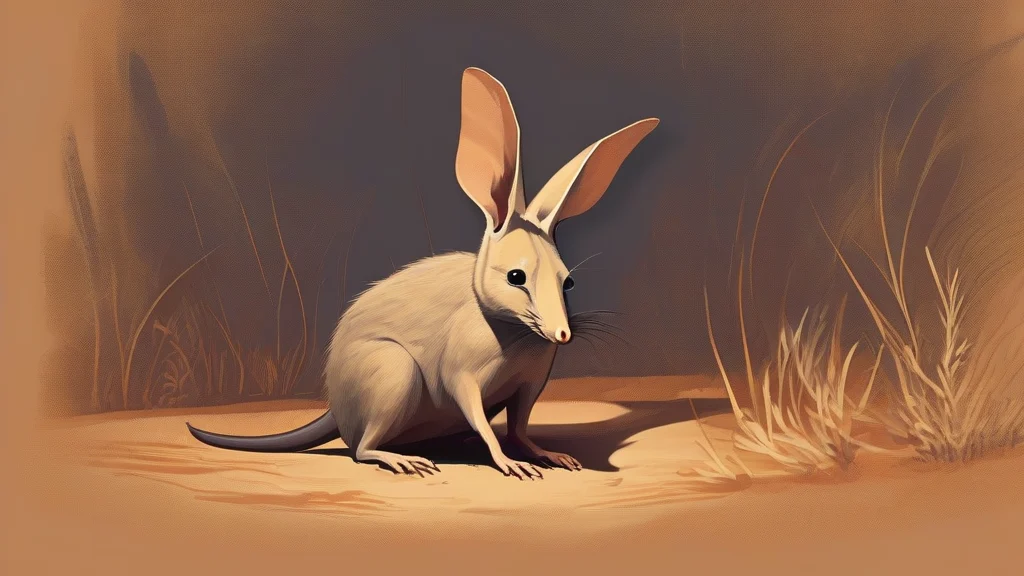
A bilby is a small, nocturnal, burrowing marsupial found in the arid and semi-arid regions of Australia. It is distinguished by its long, silky fur, long rabbit-like ears, a pointed snout, and a crested tail. Once widespread across much of the continent, the greater bilby (Macrotis lagotis) has suffered severe declines due to predation by introduced foxes and cats and competition from rabbits, and it is now classified as vulnerable, surviving mainly in protected reserves and remote desert areas. A second species, the lesser bilby, became extinct in the twentieth century. The word comes from an Aboriginal language of New South Wales and entered English through Australian usage. Beyond biology, the bilby holds cultural prominence as a national conservation symbol: it appears on wildlife campaigns, school programs, and even as an Australian alternative to the Easter Bunny, making it both an ecological emblem and a familiar term in everyday Australian life.
nounA bilby is a small, nocturnal, burrowing marsupial native to Australia, having long ears, a pointed snout, and a long tail; the greater bilby (Macrotis lagotis) is the only surviving species and is a threatened animal.
- The greater bilby (Macrotis lagotis), a threatened desert-dwelling marsupial of Australia with long rabbit-like ears.
- (Historical) The lesser bilby (Macrotis leucura), a related species declared extinct in the 20th century.
"The greater bilby digs extensive burrow systems that shelter it from the desert heat during the day."
"Zoos across Queensland run breeding programs to boost bilby numbers."
"As night fell over the Simpson Desert, a bilby emerged from its deep burrow to forage for seeds and insects."
The standard plural simply adds -s. The collective plural "bilby" occasionally appears in wildlife-management writing, but "bilbies" is preferred in general usage.
"Reintroduction programs have released dozens of bilbies into predator-free sanctuaries."
In parts of Australia, Easter has a native twist: children are taught about the 'Easter Bilby' instead of the Easter Bunny, partly to raise awareness that rabbits devastate bilby habitat.
Reviewed by Deb Chak, Editor. AI-assisted content curated by RJS Tech Solutions LLP.
Etymology of bilby
The word "bilby" derives from "bilba", a word in Yuwaalaraay, an Aboriginal language of northern New South Wales, and was adopted into Australian English in the nineteenth century as European settlers recorded Indigenous names for native fauna. It originally referred generally to the rabbit-bandicoots before becoming fixed on the surviving greater bilby. Because it enters English from an Australian Aboriginal source rather than Latin or Greek, it has no true cognates in classical languages.
How bilby is actually used
"Bilby" is used almost exclusively in Australian contexts—wildlife conservation, zoology, education—and may be unfamiliar to speakers elsewhere, who typically encounter it in nature documentaries or news coverage of Australian conservation efforts.
Easily confused with bilby
The bilby is an Australian marsupial often called the 'rabbit-eared bandicoot' because of its rabbit-like ears, but unlike the rabbit it is a pouched mammal and a threatened native species.