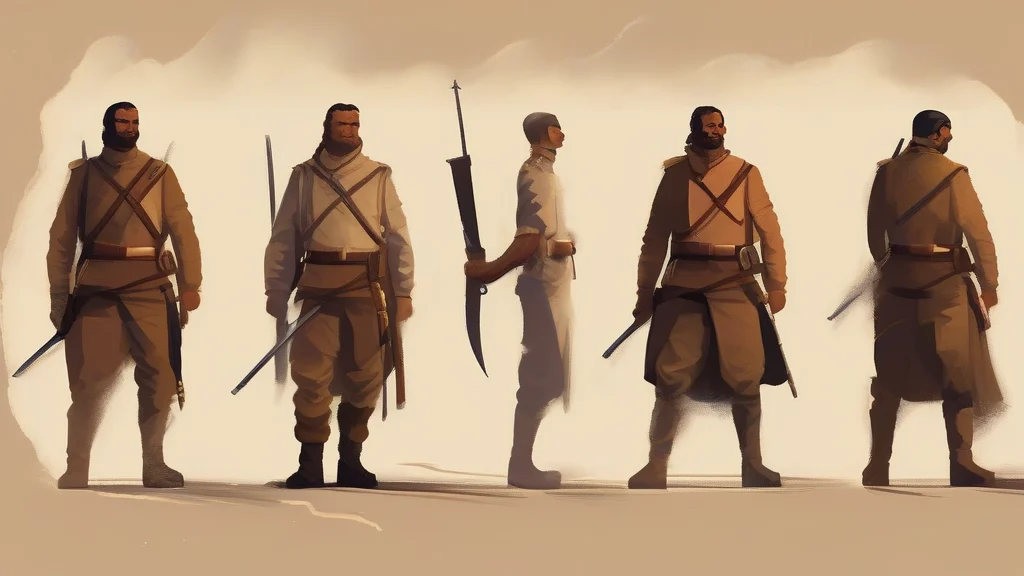
What does bandoleer mean?
A bandoleer is a broad belt worn diagonally over one shoulder and across the chest, designed to hold ammunition within easy reach. Historically, it was standard equipment for infantrymen armed with matchlock muskets: each pocket or loop on the belt carried a pre-measured charge of powder, allowing soldiers to reload quickly in battle. In modern usage, bandoleers appear with rifles and machine guns holding strips or boxes of cartridges, and the word also surfaces in historical fiction, war photography, and costume design whenever an armed figure needs visual shorthand for readiness and danger. Because of these associations, the word conveys military grit, rebellion, and urgency rather than anything domestic or formal. A closely related spelling, bandolier, refers to the same object and is equally accepted, so the two forms are effectively variants of one word. For anyone writing about warfare, history, or adventure, the bandoleer is a precise, evocative term worth knowing.
nounA broad belt worn over the shoulder and across the chest, traditionally used to carry ammunition or, occasionally, a sword. It is most strongly associated with soldiers, musketeers, and armed figures.
- A belt worn diagonally across the chest and shoulder for carrying ammunition.
- (Historical/extended use) A similar shoulder belt worn for carrying other items such as a sword or tools.
"The soldier slung a leather bandoleer of cartridges across his chest before heading to the front line."
"The musketeer adjusted his bandoleer, each wooden cartridge case clicking against the next."
"In the painting, the revolutionary wears a canvas bandoleer stuffed with rifle rounds across his chest."
Standard plural; used both for multiple belts and, historically, for the individual powder cases hung from such belts.
"The armoury wall displayed rows of leather bandoleers, each stitched with a dozen cartridge loops."
The word 'bandoleer' comes from Spanish 'bandolera' — literally a little banner — because early ammunition belts were made from strips of cloth once used to carry flags.
Reviewed by Deb Chak, Editor. AI-assisted content curated by RJS Tech Solutions LLP.
Etymology of bandoleer
The word derives from the Spanish 'bandolera', meaning a small sash or shoulder strap, which itself traces back through French 'bandoulière' and ultimately to Latin roots connected with bands and straps. English adopted the word in the late sixteenth or early seventeenth century, when matchlock musketeers wore wooden 'bandoleers' — small containers hung from such belts — to carry measured gunpowder charges. Over time, the container gave way to the belt itself as the primary meaning, and today the term denotes any ammunition belt worn across the chest. Cognates include the French 'bandoulière' and related Romance words built on the same strap-and-band root.
How bandoleer is actually used
The word carries strong military or historical connotations — it evokes soldiers, revolutionaries, and armed conflict rather than everyday civilian life. The variant spelling 'bandolier' is at least as common in modern usage; writers should be consistent within a single text.
Easily confused with bandoleer
Bandolier is simply a variant spelling (and arguably more common form) of the same word; both refer to an over-the-shoulder ammunition belt, so they are interchangeable rather than truly distinct words.
A baldric is a belt worn over the shoulder to carry a sword, whereas a bandoleer specifically carries ammunition.