What does bandstand mean?
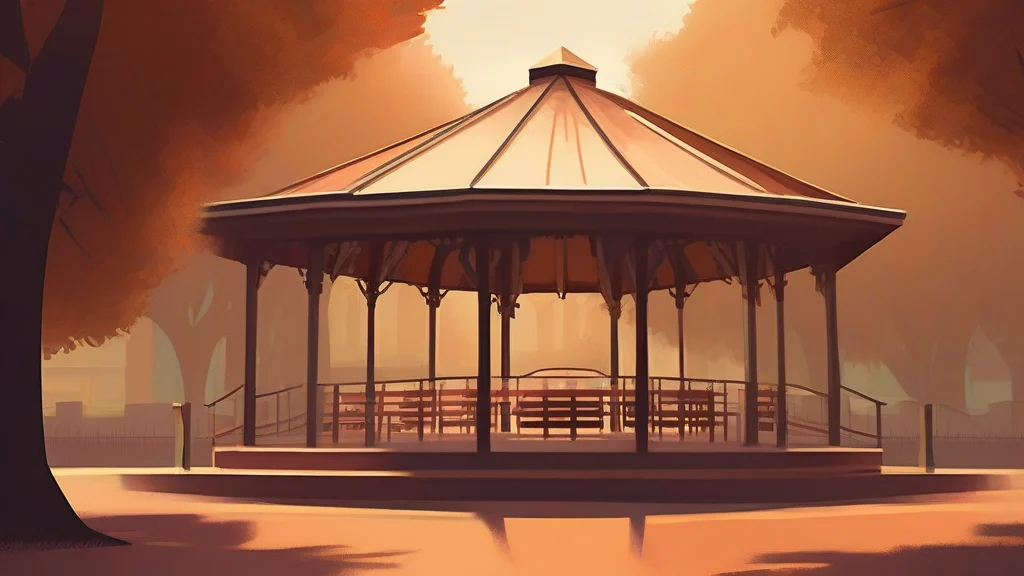
A bandstand is a raised, usually roofed outdoor structure built for musical performances, most commonly by brass or military bands, and typically found in public parks, gardens, and seaside promenades. The word became widespread during the Victorian era, when towns across Britain erected decorative cast-iron bandstands as centrepieces of their new municipal parks, and the fashion spread throughout the British Empire. In North America, bandstands appeared in town squares and park settings, often serving community concerts and dances. Architecturally, bandstands are usually circular or polygonal, open at the sides so sound can carry, and frequently crowned with an ornate roof. Beyond its literal meaning, the word has occasionally been used figuratively to describe any public platform for display or performance. Today, surviving historic bandstands are often restored as heritage attractions, and many continue to host live music, keeping a nineteenth-century tradition alive in contemporary public life.
nounA raised open-air platform, typically roofed but open on the sides, on which a band performs music, especially in a park or public garden.
- An outdoor platform or pavilion for musical performances by a band, typically found in parks and public gardens.
- (Figurative, chiefly British informal) A place of public prominence or exposure — used in expressions such as 'the political bandstand' to mean a public forum for self-display.
"The brass band struck up a Sousa march from the bandstand in the park."
"Couples danced around the bandstand while the big band played into the evening."
"The council restored the Victorian bandstand at the heart of the seafront gardens."
Standard plural form; used when referring to multiple such structures.
"The city's Victorian bandstands were all restored ahead of the anniversary celebrations."
Victorian Britain built thousands of ornate iron bandstands in its parks — and many survive today as beloved landmarks, still hosting summer concerts more than a century later.
Reviewed by Deb Chak, Editor. AI-assisted content curated by RJS Tech Solutions LLP.
Etymology of bandstand
Bandstand is a straightforward compound of two English words: 'band', meaning a group of musicians (a word that entered English from French 'bande', ultimately of Germanic origin), and 'stand', meaning a structure or position to stand on. It arose naturally in the nineteenth century as purpose-built outdoor performance structures became common features of public parks. Its closest relatives are other English compounds built on 'stand', such as grandstand and handstand; it has no separate cognate lineage beyond the Germanic roots shared with those words.
How bandstand is actually used
The word is most strongly associated with Victorian and Edwardian public parks, particularly in Britain, where surviving examples are often heritage-listed. The figurative sense is rare today and mostly historical.
Easily confused with bandstand
A grandstand is a large covered seating structure for spectators at sports events, whereas a bandstand is an outdoor platform for musicians to perform on.