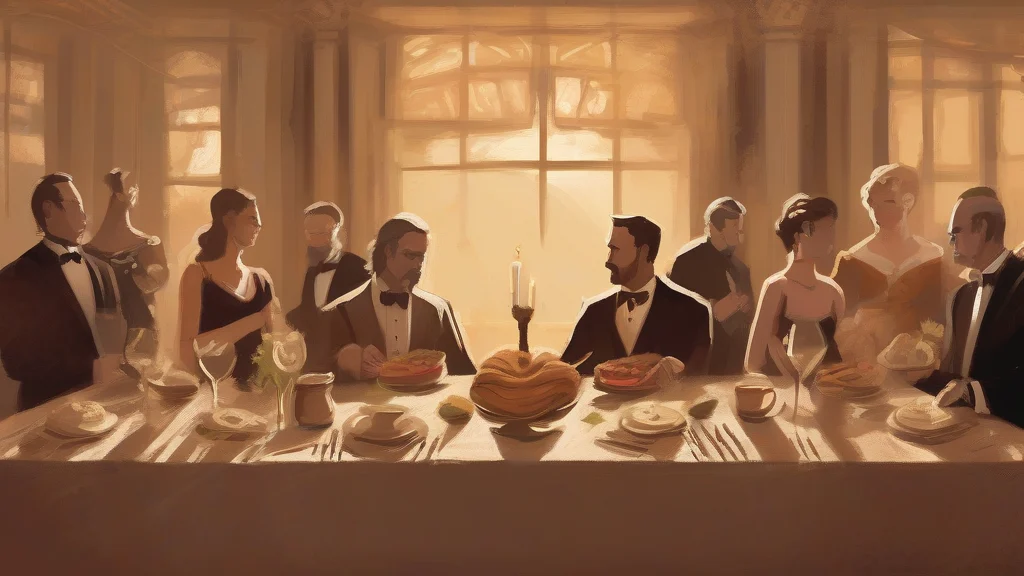
What does banqueted mean?
Banqueted is the past tense of the verb 'banquet', which means to entertain someone with a lavish feast or, intransitively, to feast sumptuously oneself. When a person or group was banqueted, they were received with elaborate ceremony and abundant food and drink — the word evokes state dinners, medieval halls laden with roasted meats, and formal celebrations of victory or alliance. Because it implies generosity on a grand scale, 'banqueted' carries connotations of honor, luxury, and occasion; one does not get banqueted over a quick lunch. The word appears chiefly in historical writing, literature, and journalism describing ceremonial hospitality, and it is more common in passive form ('the ambassadors were banqueted') than in everyday speech. Its noun sibling, 'banquet', remains far more familiar today, but 'banqueted' offers writers a vivid, slightly old-world way to describe being royally fed and feted.
verb (past tense and past participle of 'banquet')Banqueted is the past tense and past participle of the verb 'banquet', meaning to have been entertained at a lavish feast or to have feasted sumptuously.
- To have been entertained with a lavish feast or elaborate meal.
- (Intransitive) To have feasted or dined sumptuously oneself.
"The visiting dignitaries were banqueted for hours in the great hall."
"After the coronation, the new king banqueted his allies in the palace's grandest chamber."
"They banqueted on roast pheasant and spiced wine late into the night."
The words 'banquet' and 'benches' are linguistic cousins — a banquette is literally a little bench, because early banquets were eaten while seated on benches in the hall!
Reviewed by Deb Chak, Editor. AI-assisted content curated by RJS Tech Solutions LLP.
Etymology of banqueted
Banqueted derives from 'banquet', a word that entered English from French in the 15th century. The French term traces back through Italian 'banchetto' (a little bench), from 'banco', meaning bench — reflecting the fact that early feasts were taken seated on benches. Over time the word shifted in meaning from the furniture of dining to the meal itself, and the verb 'to banquet' developed to describe both hosting such a feast and partaking of one. Cognates appear across Romance languages, including Italian 'banchetto' and French 'banquet'.
Related word forms
How banqueted is actually used
'Banqueted' carries an elevated, formal register and appears most often in historical, literary, or journalistic descriptions of ceremonial hospitality. It is rarely used in everyday modern speech; passive constructions ('they were banqueted') are more common than active ones. The verb implies abundance and ceremony rather than an ordinary meal.
Easily confused with banqueted
A banquette is a long upholstered bench, whereas banqueted describes having been feasted lavishly — the two words share a root but mean entirely different things.