
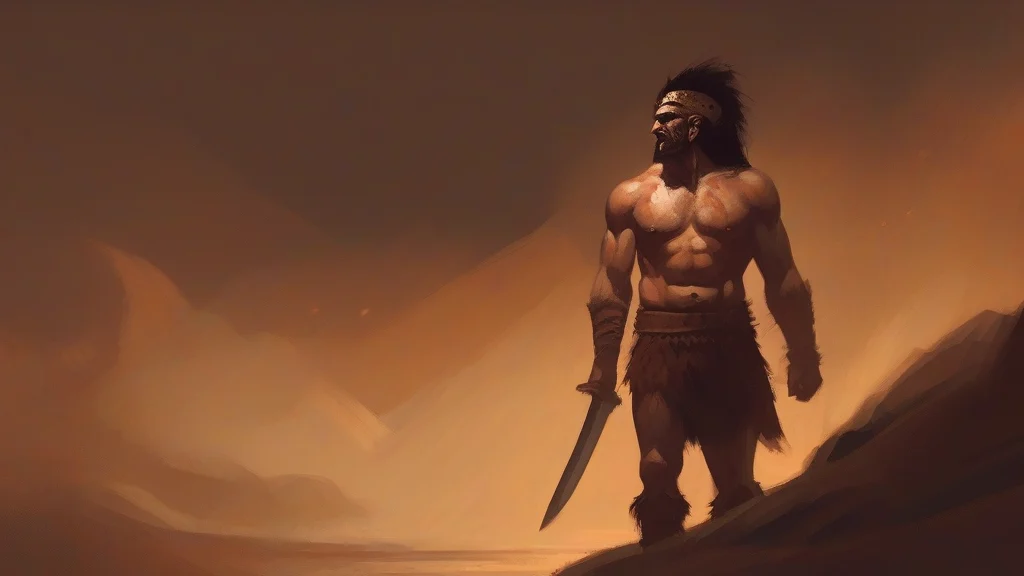
What does barbarian mean?
A barbarian is a person viewed as uncivilized, primitive, or culturally inferior — typically from the perspective of the society doing the labeling. The term originated with the ancient Greeks, who applied it to all non-Greek speakers on the grounds that foreign languages sounded like unintelligible babbling ('bar-bar'), and the Romans later adopted it for peoples beyond their empire's frontiers. Historically, 'the barbarians' most famously refers to the various tribes — Goths, Vandals, Huns and others — whose migrations and invasions contributed to the fall of the Western Roman Empire. Today the word appears both in historical contexts, such as accounts of barbarian invasions, and in figurative use as a stinging insult for someone crude, violent, or lacking refinement: calling someone a barbarian implies they are a philistine or a brute. Because it is inherently comparative and derogatory, careful writers recognize that it reflects the biases of the culture using it as much as any quality of the people described.
An uncivilized, primitive, or culturally inferior person; historically, one of the peoples outside Greco-Roman civilization, especially those who invaded the Roman Empire.
"The Roman legions struggled to hold back the barbarians pressing against the northern frontier."
Almost always carries a derogatory connotation; in historical scholarship the term may be used neutrally to describe these groups, though modern historians often prefer more specific tribal names.
Relating to or characteristic of barbarians; uncivilized, crude, or brutally violent.
"The invaders left a trail of barbarian destruction across the countryside."
The standard plural is simply 'barbarians.' It is frequently used collectively, as in 'the barbarian invasions,' referring to the peoples whose movements contributed to the fall of the Western Roman Empire.
"Barbarians sacked the city in 455, leaving little standing."
The word 'barbarian' comes from the Greeks mocking foreign languages as sounding like 'bar-bar' — meaningless babbling — so every non-Greek speaker was literally called a 'babble-er.'
Reviewed by Deb Chak, Editor. AI-assisted content curated by RJS Tech Solutions LLP.
Etymology of barbarian
The word derives ultimately from Greek 'barbaros,' meaning foreign or non-Greek, which arose from the perception that foreign speech sounded like 'bar-bar' — meaningless babbling. Latin borrowed the term as 'barbarus,' preserving the same sense of an outsider to Greco-Roman civilization. English adopted the word via medieval French and Latin, with 'barbarian' attested by around the mid-16th century, alongside related forms such as 'barbarous,' 'barbaric,' and 'barbarism.' The noun's strong association with the tribes who overran the Roman Empire cemented its enduring image of the uncivilized outsider.
Related word forms
How barbarian is actually used
The term is strongly relative and pejorative: it has always been applied by one culture to outsiders it deemed inferior. In modern use it is often figurative (an insult for someone crude or tasteless) rather than literal. It is common in historical writing about the fall of Rome, fantasy fiction, and casual insults alike.
Easily confused with barbarian
'Barbarian' is a noun denoting an uncivilized person, while 'barbarous' is an adjective describing something cruelly brutal or coarse in manner.
'Barbarian' names a person, whereas 'barbaric' describes behavior, taste, or conditions that are crudely violent or unsophisticated.