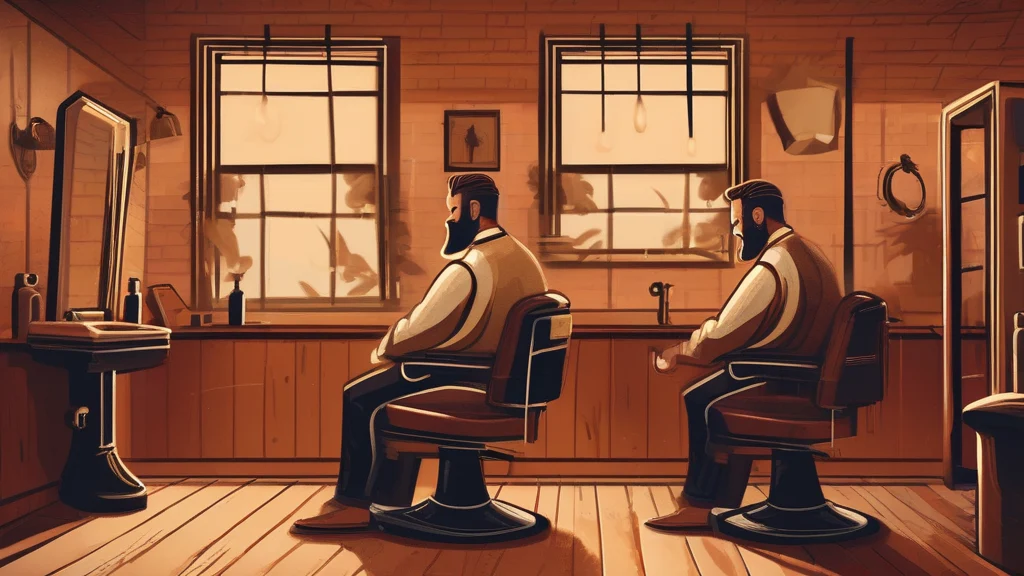
What does barbering mean?
Barbering is the trade and practice of cutting hair, shaving, and trimming beards, most commonly associated with men's grooming. As a noun, it can denote either the profession as a whole or the specific activity of performing such work. The word appears frequently in vocational and commercial contexts — barbering schools, barbering licenses, barbering services — and has gained renewed cultural visibility with the recent revival of traditional barbershops offering straight-razor shaves and classic cuts. Barbering is closely related to but distinct from hairdressing: while hairdressing generally covers styling, coloring, and treatments for all clients, barbering traditionally centers on men's haircuts and facial-hair grooming. The word derives from 'barber,' itself rooted in the Latin 'barba' meaning beard. Its connotations are largely positive, evoking craftsmanship, tradition, and personal care, making it a useful term in discussions of trades, grooming culture, and small-business life.
nounThe trade, practice, or occupation of cutting hair and shaving or trimming beards; also used more broadly to refer to the craft of men's grooming.
- The profession or trade of cutting hair, shaving, and trimming beards
- The activity or skill of performing such grooming work
"After twenty years of barbering in the same shop, he knew every regular by name and by haircut."
"She trained for a year before opening her own barbering studio downtown."
"Traditional barbering, with its hot towels and straight razors, has seen a real revival among younger customers."
In medieval Europe, barbers didn't just cut hair — they performed surgery and dentistry too, which is why the red-and-white barber pole still symbolizes blood-soaked bandages today.
Reviewed by Deb Chak, Editor. AI-assisted content curated by RJS Tech Solutions LLP.
Etymology of barbering
Barbering derives from 'barber,' which entered English from Anglo-Norman French 'barbour' and ultimately from the Latin 'barba,' meaning beard. The related Latin adjective 'barbatus' (bearded) gave rise to English words such as 'barbate.' The trade itself has ancient roots, with barbers documented across classical antiquity, and in medieval Europe barbers famously combined hair-cutting with surgery and dentistry before the professions separated. Cognates sharing the Latin root include 'barbershop' and other beard-related terms.
Related word forms
How barbering is actually used
Barbering is a common noun referring both to the profession itself and to the act of practicing it. It carries neutral-to-positive connotations and is often used in vocational contexts (e.g., barbering courses, barbering licenses). It is distinct from hairdressing, which typically encompasses styling and coloring for all clients rather than focusing on men's cuts and shaves.
Easily confused with barbering
Barbering is the legitimate trade of cutting hair and shaving, while barbarism refers to crude or uncivilized behavior or language — the two words share distant Latin roots but nothing else.