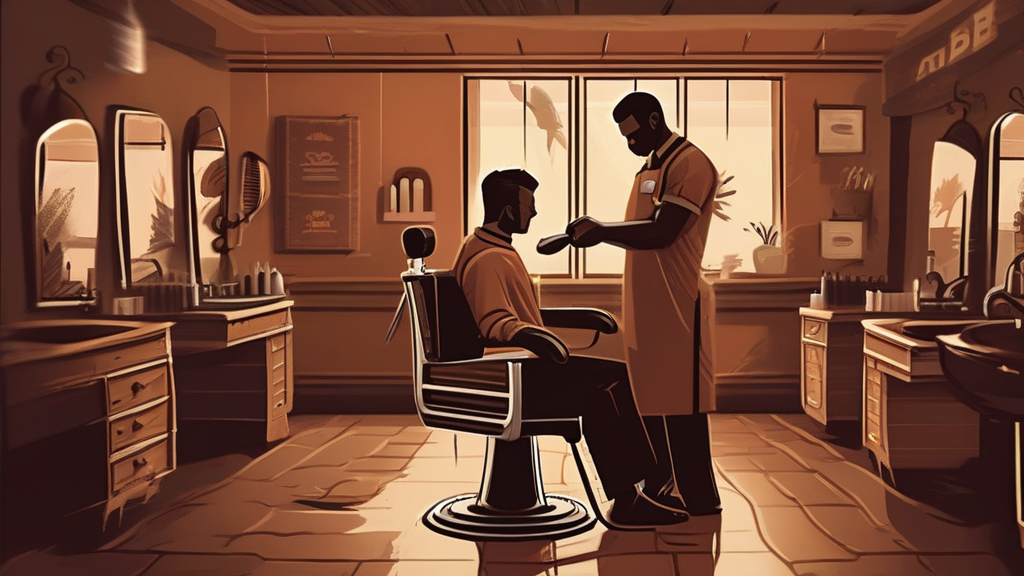
What does barber mean?
A barber is a person whose profession is cutting hair — especially men's hair — and shaving or trimming facial hair such as beards and mustaches. The word applies to both the individual practitioner and, by extension, the establishment where they work, commonly called a barbershop. Barbers have held a distinctive place in society for centuries: in medieval Europe they doubled as surgeons and dentists, a history still echoed today in the red-and-white striped barber pole that hangs outside many shops. In modern usage, 'barber' carries no particular formality or connotation beyond its association with men's grooming, and it contrasts loosely with 'hairdresser' or 'stylist,' terms more often applied to those who cut and style women's hair or offer broader salon services. Visiting a barber remains a routine social ritual in many cultures, and the barbershop itself has long served as a community gathering place as much as a place of business.
A person whose occupation is cutting men's hair and shaving or trimming beards.
"The barber draped a cape over his shoulders before picking up the scissors."
Often used attributively in compounds like 'barbershop' or 'barber pole.'
To cut or style someone's hair, especially in the manner of a barber.
"He barbers out of a small studio downtown."
Relatively rare; most speakers prefer 'cut hair' or 'give a haircut.'
Standard plural; used when referring to multiple practitioners of the trade.
"The guild of barbers regulated the trade in medieval London."
The red-and-white barber pole is a relic of medieval times, when barbers also performed surgery and bloodletting — the red symbolized blood and the white symbolized bandages.
Reviewed by Deb Chak, Editor. AI-assisted content curated by RJS Tech Solutions LLP.
Etymology of barber
The word 'barber' comes from the Anglo-Norman French 'barbour,' derived from the Late Latin 'barbator,' which in turn stems from the Latin 'barba,' meaning 'beard.' It entered English in the Middle Ages, when barbers were closely associated with beard-trimming and shaving. The shared Latin root 'barba' also gives us related words such as 'barb' (the pointed projection on a hook or arrow) and 'barbate' (bearded), while the pejorative sense of 'barbarian' arose from a different but phonetically similar Greek notion of unintelligible speech, later influenced by the same Latin root.
Related word forms
How barber is actually used
Barber is a neutral, everyday word with no strong connotation. In American usage it typically implies a men's hairdresser, often contrasted with 'hairdresser' or 'stylist' (which may serve any client). In British English, 'barber' is similarly associated with men's grooming. The verb form 'to barber' exists but is uncommon; most people say 'get a haircut' rather than 'get barbered.'
Easily confused with barber
A barber cuts hair for a living, while a barbarian refers historically to a person from a foreign, 'uncivilized' culture — both trace to the Latin root barba (beard), but their meanings are entirely unrelated in modern use.