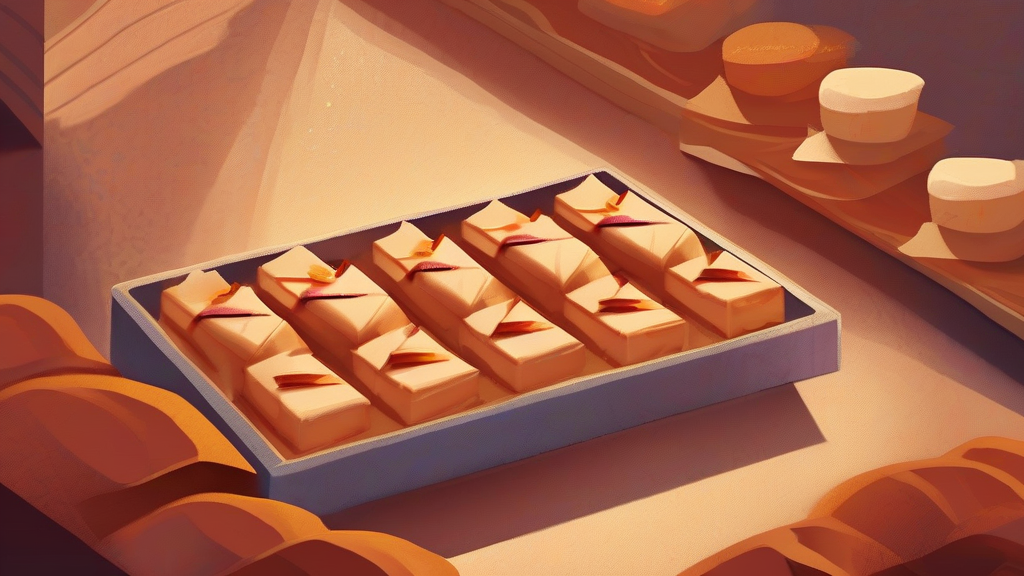
What does barfi mean?
Barfi is a dense, fudge-like sweet originating from the Indian subcontinent, made by simmering milk and sugar together until thickened, then setting the mixture into firm blocks that are cut into small squares or diamonds. It is frequently flavoured with cardamom, rose water, pistachios, almonds, or coconut, and variations such as kaju (cashew) barfi and pista (pistachio) barfi are especially popular. The name derives from the Persian word 'barf', meaning snow, a reference to the sweet's characteristically pale, snowy white appearance — though many modern versions are coloured or tinted with ingredients like saffron or chocolate. Barfi holds an important place in South Asian culture, where it is served at weddings, religious festivals such as Diwali, and other celebrations, and it is widely exchanged as a gift. Outside South Asia, the word is best known in Britain and among diaspora communities, appearing on menus of Indian restaurants and in specialist sweet shops.
nounA dense, fudge-like South Asian sweet made from condensed milk and sugar, often flavoured with cardamom, nuts, or coconut, and typically cut into small squares or diamonds.
- A dense, milky South Asian confection made from condensed milk and sugar, often flavoured with nuts or spices.
"She arranged the pistachio barfi on a silver platter for the Diwali guests."
"The bakery's almond barfi sold out within hours of opening."
"He brought a box of kaju barfi as a gift when visiting his grandmother."
Barfi is typically treated as a mass noun referring to the type of sweet, so no plural inflection is required; 'barfis' appears occasionally but is not standard.
"They bought several kinds of barfi for the festival."
Barfi literally means 'snow' in Persian — a fitting name for a sweet so pale and cool it melts on the tongue like winter itself.
Reviewed by Deb Chak, Editor. AI-assisted content curated by RJS Tech Solutions LLP.
Etymology of barfi
Barfi comes from the Persian word 'barf' (برف), meaning 'snow' or 'ice', referring to the sweet's pale, milky-white appearance. The word entered South Asian languages during the Mughal period, when Persian was the court language, and became established across Hindi, Urdu, Bengali, and other regional languages. The variant spelling 'burfi' is equally common, and both forms are now recognised in English dictionaries.
How barfi is actually used
Barfi is used primarily in British English and among South Asian diaspora communities; it appears most often in culinary and cultural contexts. The plural is usually left unchanged ('barfi') since it refers to a type of sweet rather than countable individual pieces.
Easily confused with barfi
Burfi is simply a common variant spelling of the same sweet; both words refer to identical confections, with 'barfi' deriving from the Persian word for snow/ice.
Halva is a different dense sweet made from sesame paste, semolina, or flour rather than condensed milk.