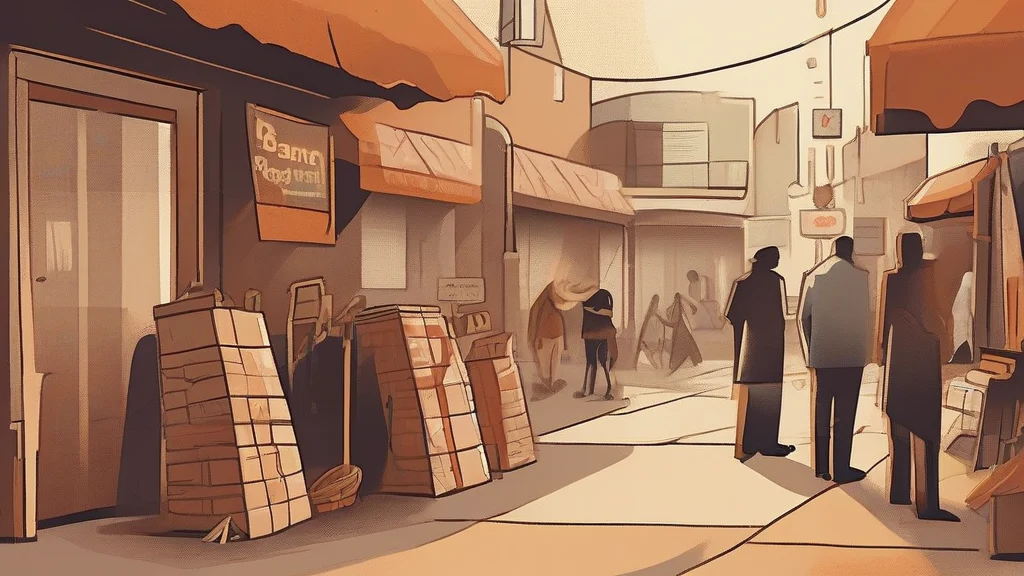
What does bargain mean?
Bargain is one of those everyday words that works equally well as a noun and a verb. As a noun, it refers either to an agreement struck between two parties over the terms of a sale or exchange, or to something purchased at a notably favorable price — the sense behind phrases like 'a real bargain.' As a verb, it means to negotiate those terms, as when buyers and sellers haggle until both sides are satisfied. The word carries broadly positive connotations: finding a bargain suggests shrewdness and thrift, while striking a bargain implies successful mutual agreement. Its history traces back through Old French to medieval trade, when merchants literally bargained over goods brought by ship. Common collocations include 'strike a bargain,' 'drive a hard bargain,' and 'into the bargain.' Whether in commerce, diplomacy, or everyday shopping, bargain captures the essential human activity of negotiating value.
An agreement between two or more parties establishing the terms of a sale or exchange; also, an item acquired for less than its usual price.
"The two companies reached a bargain that satisfied both boards."
When referring to a cheap purchase, 'bargain' is almost always positive in tone.
To negotiate the terms of a transaction or agreement, especially over price.
"They bargained with the vendor for nearly an hour before settling on a price."
Often used in the form 'bargain with someone over/for something.'
Standard plural, used chiefly for multiple good-value purchases or multiple agreements.
"The clearance rack was full of bargains."
The word 'bargain' comes from the same Old French root as 'barge' — the boat — because merchants once struck their deals at the waterfront where ships unloaded their goods.
Reviewed by Deb Chak, Editor. AI-assisted content curated by RJS Tech Solutions LLP.
Etymology of bargain
Bargain entered Middle English from Old French 'bargaignier', meaning to haggle or negotiate. The Old French term itself likely derives from a Frankish Germanic root related to 'borg' (pledge) or possibly connected to words for boats and trading at the waterfront. Cognates appear in other Romance languages, such as Spanish 'trueque'-related trading terms and Italian forms of bargaining vocabulary. The word has been part of English commercial life since the medieval period, reflecting the importance of trade and negotiation in that era.
Related word forms
How bargain is actually used
In everyday speech, 'bargain' often carries a positive connotation of getting good value. The phrase 'drive a hard bargain' describes someone who negotiates aggressively and can carry a slightly negative tone. In British English, 'into the bargain' means 'in addition'.
Easily confused with bargain
A barge is a flat-bottomed boat; it shares a distant root with bargain but has nothing to do with buying or negotiating.
Bartering is exchanging goods directly without money, while a bargain is any negotiated agreement or good-value purchase.