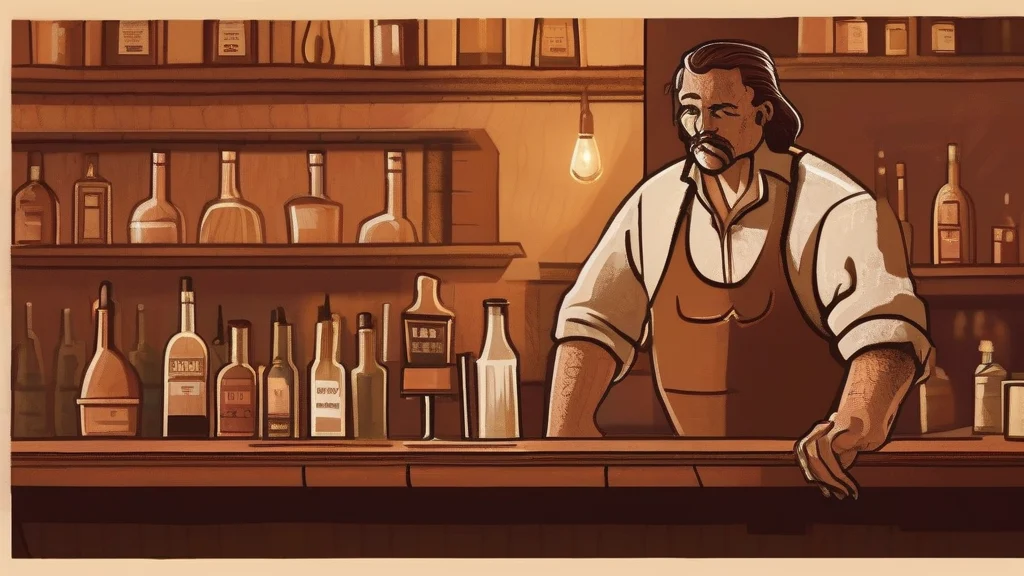
What does barkeep mean?
Barkeep is an informal noun meaning a person who serves drinks behind the counter of a tavern, saloon, or pub — in modern terms, a bartender. Formed by fusing "bar" with the verb "keep," it emerged in nineteenth-century America, where the clipped form suited the rapid rhythms of saloon speech and became a stock figure in Western fiction: the grizzled man polishing glasses, trading gossip, and calling last orders. Today the word is rarely used in professional settings, where "bartender" is the neutral standard, but it survives in historical fiction, film, and casual conversation precisely because of its colorful, period flavor. Calling someone a barkeep instantly evokes sawdust floors, brass rails, and whiskey barrels, giving writers and speakers a compact way to signal atmosphere as well as occupation. For learners, it is best understood as a folksy synonym of bartender rather than a distinct job title.
nounA person who serves drinks behind the bar of a tavern or saloon; a bartender, especially in older or informal American usage.
- A person who tends bar and serves alcoholic drinks in a tavern, saloon, or pub; a bartender (informal, often evocative of 19th-century American usage).
"The barkeep slid a fresh pint across the counter with practiced ease."
"The grizzled barkeep polished glasses and traded gossip with the regulars."
"In her Western novel, every scene ended with the barkeep calling time at the saloon."
The plural follows the regular English pattern of adding -s.
"Both barkeeps worked the long oak counter on Saturday nights."
"Barkeep!" — the classic saloon shout survives from the 1800s, when this clipped little word was the fastest way to summon the man behind the whiskey barrels.
Reviewed by Deb Chak, Editor. AI-assisted content curated by RJS Tech Solutions LLP.
Etymology of barkeep
Barkeep is an English compound formed from "bar" (the counter over which drinks are served) and "keep" (to tend or maintain), functioning as a reduced form of the earlier compound "barkeeper." Both compounds arose in American English during the nineteenth century, alongside related occupational compounds such as "innkeeper" and "storekeeper," which share the same verbal root. The word's fortunes are tied to the saloon culture of the American frontier, which fixed its folksy, period associations.
How barkeep is actually used
Barkeep is informal and somewhat archaic-flavored; it carries a folksy, Old West or Victorian saloon connotation. In modern professional contexts, "bartender" is preferred. The word is chiefly North American, though it is understood elsewhere through Western fiction and film.
Easily confused with barkeep
Bartender is the standard modern term for someone who mixes and serves drinks at a bar, while barkeep is an older, more colloquial synonym with a folksy, period flavor.
Barkeeper is a fuller variant of the same compound noun, whereas barkeep is its shortened form.