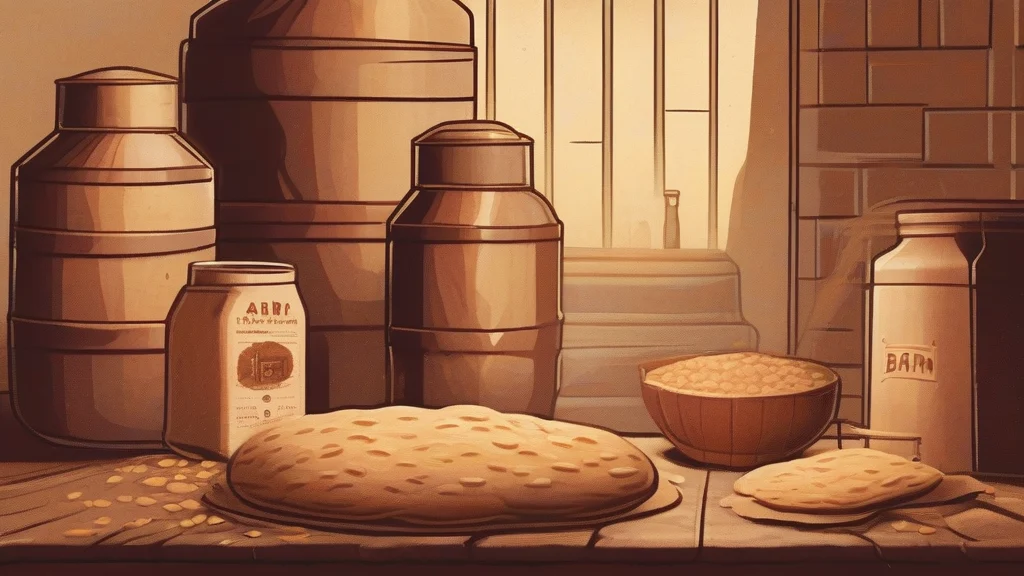
What does barm mean?
Barm is the frothy, yeast-laden foam that forms on the surface of malt liquor while it ferments. Before commercial yeast became widely available, this foam was carefully skimmed off and used as the primary leavening agent in bread-making, giving baked goods their rise. The word is firmly rooted in British brewing and baking tradition, and it survives today mainly through regional food terms: in northern England, a soft white bread roll is commonly called a 'barm cake', while in Ireland, 'barmbrack' is a traditional fruited loaf whose name preserves the ingredient's memory. Although modern bakers rarely use true barm, preferring cultivated yeast, the word retains a warm, rustic charm and appears frequently in discussions of historical cookery, traditional brewing, and regional dialect. For readers interested in food history, barm offers a vivid link between the brewhouse and the bakery, two crafts that were once closely intertwined in everyday domestic life.
nounThe frothy yeast that forms on the surface of fermenting malt liquor, historically used as a leavening agent in baking.
- The yeasty froth or foam that rises to the surface during the fermentation of malt liquor, used as a raising agent in baking.
"The brewer skimmed the barm from the top of the fermenting ale and set it aside for the baker."
"She stirred a spoonful of barm into the dough and left it to rise overnight by the fire."
"In old Lancashire kitchens, fresh barm from the brewery was prized above any other leavening for light, well-risen loaves."
Rarely pluralized; barm is typically treated as an uncountable mass noun referring to the froth itself.
"Different breweries' barms were traded among village bakers for their distinctive rising qualities."
Before packets of dried yeast existed, British bakers leavened their bread with the froth skimmed off the local brewery's ale — and in parts of northern England, a bread roll is still called a 'barm cake' to this day.
Reviewed by Deb Chak, Editor. AI-assisted content curated by RJS Tech Solutions LLP.
Etymology of barm
Barm derives from the Old English word 'beorma', meaning yeast or fermented froth, making it one of the older survivals in the English culinary vocabulary. Its further origins are uncertain, though it has been linked to Germanic roots connected with fermentation. The word has been in continuous use since the medieval period, when ale and bread were staples produced in the same households, and its derivatives such as 'barmy' (originally meaning full of barm, later 'foolish') entered English through the same brewing tradition.
Related word forms
How barm is actually used
Barm is now chiefly of historical and regional interest, surviving most visibly in northern English food names such as the 'barm cake' (a soft bread roll) and Irish 'barmbrack' (a fruited loaf traditionally made with barm). The word carries a rustic, traditional connotation.
Easily confused with barm
A berm is a flat strip of land or ledge beside a road, ditch, or embankment, whereas barm is the yeast froth from fermenting liquor.