
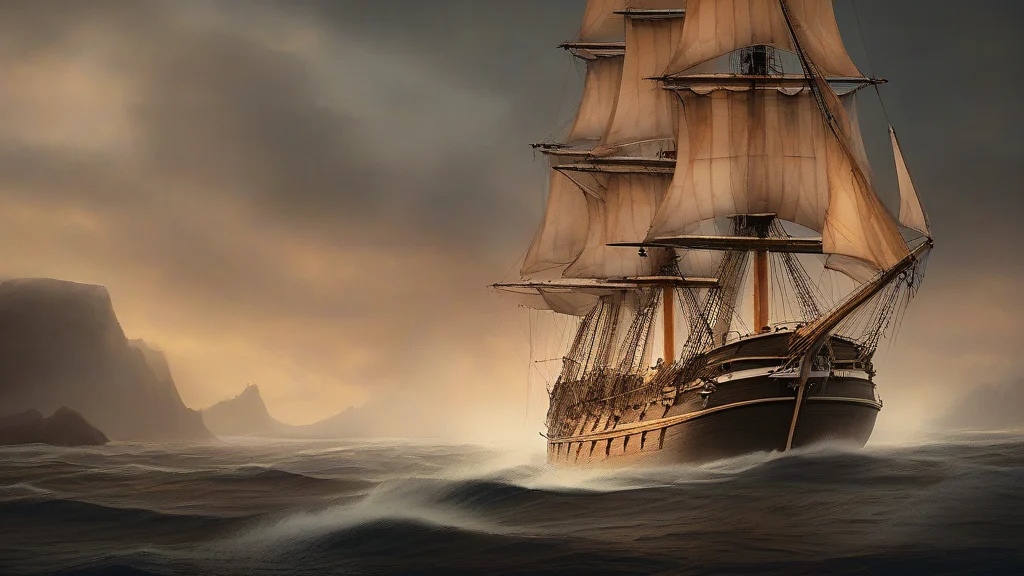
What does barquentine mean?
A barquentine is a sailing vessel with three or more masts in which only the foremost mast carries square sails, while the remaining masts are rigged fore-and-aft. This hybrid arrangement gave late-nineteenth-century merchant ships much of the driving power of a full-rigged ship while requiring a far smaller crew, since fore-and-aft sails are easier to manage than acres of square canvas. Barquentines were widely used for cargo carrying in the age of sail and survive today chiefly as restored museum ships and sail-training vessels. The word derives from 'barque', the older name for a similar but more heavily square-rigged vessel, and the American spelling 'barkentine' reflects the same root. For readers of maritime history, the term marks one of the many refinements by which nineteenth-century shipbuilders balanced speed, economy, and crew size.
nounA three-masted sailing vessel in which the foremast is square-rigged and the main and mizzen masts are rigged fore-and-aft. It combines the handling advantages of a schooner with some of the sail power of a fully square-rigged ship.
- A sailing vessel of three or more masts, square-rigged only on the foremost mast and fore-and-aft rigged on the others.
"The restored barquentine slipped quietly out of the harbour under fore-and-aft canvas."
"The museum's prize exhibit is a 19th-century barquentine that once carried timber across the Atlantic."
"Cadets spent the summer aboard a training barquentine, learning to handle its fore-and-aft sails."
Standard regular plural; occasionally written 'barkentines' in American usage.
"Several barquentines still sail as training vessels today."
Despite its name suggesting a small barque, a barquentine actually trades away most of its square sails for ease of handling — a favourite rig of late-19th-century merchant captains running short-handed crews.
Reviewed by Deb Chak, Editor. AI-assisted content curated by RJS Tech Solutions LLP.
Where does barquentine come from?
The word barquentine was formed in the mid-nineteenth century from 'barque' — itself borrowed into English from French, ultimately from Latin 'barca', meaning a small boat — combined with the suffix '-entine', apparently influenced by 'brigantine'. It names a rig intermediate between the barque and the schooner. The variant spelling 'barkentine' preserves the older English form 'bark'.
How barquentine is actually used
A technical term of maritime history and tall-ship sailing, encountered mainly in nautical literature, museum contexts, and accounts of historic merchant vessels. The spelling 'barkentine' is an accepted American variant.
Easily confused with barquentine
A brigantine has two masts, whereas a barquentine has three or more, with only the foremast square-rigged.
A barque carries square sails on all masts except the rearmost (mizzen), while a barquentine is square-rigged on the foremast alone.