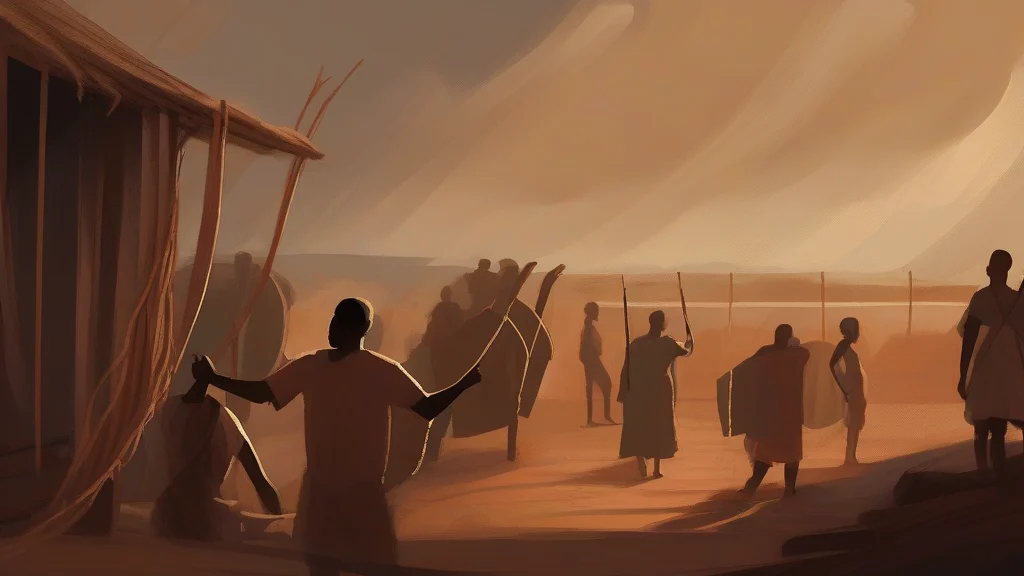
What does barracoon mean?
A barracoon is an enclosure — typically a stockaded compound or long, low barrack-like building — in which enslaved Africans were held temporarily before being loaded onto ships during the transatlantic slave trade. The term derives from the Spanish 'barracón', an augmentative form meaning a large hut or shed, and entered English through accounts of the West African coast, where such structures stood near ports and trading posts. Captives could spend days or weeks in these compounds awaiting sale and embarkation, making the barracoon a grim threshold between inland capture and the Middle Passage. Today the word survives almost entirely in historical contexts: scholarly works on the slave trade, museum exhibits, and fiction set in the era. Because it is so tightly bound to the history of slavery, it carries strong connotations of confinement and dehumanization, and it is used almost exclusively when discussing that period rather than as a general term for enclosures.
nounAn enclosure or compound in which enslaved Africans were confined temporarily before being transported across the Atlantic during the transatlantic slave trade.
- A temporary enclosure or barrack-like structure on the African coast in which enslaved people were confined while awaiting shipment across the Atlantic.
- More generally, any similar enclosure used to hold captives or laborers before transport.
"The captives were held in a barracoon on the coast for weeks before the ship arrived."
"Historians studying the slave trade have mapped the sites of the barracoons that once lined the West African coast."
"In her novel, the protagonist endures the sweltering confinement of a barracoon before being forced aboard a slave ship."
Standard plural; often used when referring to multiple such enclosures along a stretch of coastline.
"The ruins of several barracoons still stand near the old trading fort."
The word 'barracoon' comes from the Spanish 'barracón' — literally an oversized hut — and it preserves in a single term one of the darkest waiting rooms in human history.
Reviewed by Deb Chak, Editor. AI-assisted content curated by RJS Tech Solutions LLP.
Etymology of barracoon
Barracoon comes from the Spanish 'barracón', an augmentative of 'barraca', meaning a large hut or rough shelter built of poles and thatch. The word was adopted into English, likely in the seventeenth century, through European traders' descriptions of the fortified enclosures on the West African coast where enslaved people were assembled before shipment. It shares its underlying root — the notion of a simple barrier or bar-like structure — with words such as 'barracks' and 'barricade'.
How barracoon is actually used
The word is almost exclusively historical and appears chiefly in academic writing, museum interpretation, and literature dealing with the transatlantic slave trade. It carries heavy connotations of suffering and captivity and should be used with appropriate gravity.
Easily confused with barracoon
A raccoon is a nocturnal mammal, while a barracoon is a historical enclosure for holding enslaved people.