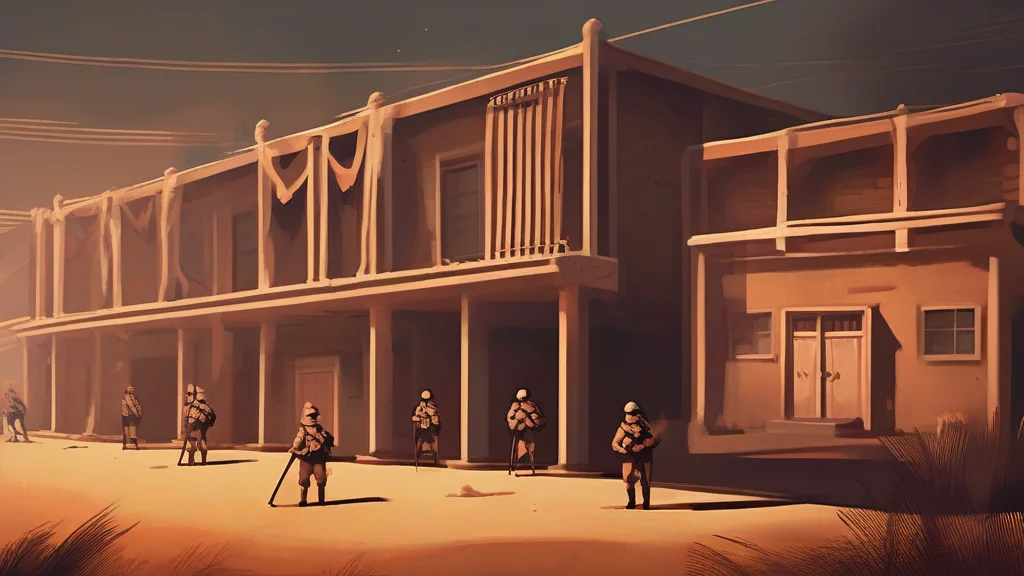
What does barrack mean?
A barrack is a building, or more commonly a complex of buildings, erected to accommodate soldiers; the term is most familiar in its plural form, 'barracks', which denotes the quarters in which troops live, eat, and sleep on military installations. The word carries a firmly institutional, martial flavour, appearing in phrases such as 'army barracks' and 'the men returned to barracks'. Separately, chiefly in British and Australian English, 'barrack' functions as a verb describing the noisy behaviour of spectators who shout encouragement ('barrack for') or taunts ('barrack against') at sportspeople. This sporting sense gives the word a colourful, colloquial dimension quite distinct from its military one. Derived forms include the plural noun 'barracks' and the verbal nouns 'barracking' and agentive 'barracker'. Understanding 'barrack' therefore requires holding two threads together: the austere world of military accommodation and the raucous atmosphere of the grandstand.
A building or group of buildings used to house soldiers.
"The new barracks could accommodate an entire battalion."
Usually used in the plural form 'barracks', which also functions as a collective singular.
(Chiefly British and Australian) To shout at a player, team, or contestant, either in support or in derision.
"The home crowd barracked the visiting goalkeeper mercilessly."
Rare in American English, where it generally retains only the supportive meaning.
'Barracks' is the standard plural, though it is frequently treated as a collective singular in military contexts.
"The barracks on the base housed over five hundred personnel."
In Australia and Britain, 'barracking' isn't about buildings at all — it's what rowdy fans do from the stands, whether cheering their team on or heckling the opposition.
Reviewed by Deb Chak, Editor. AI-assisted content curated by RJS Tech Solutions LLP.
Etymology of barrack
'Barrack' entered English in the late 17th century from French 'baraque' or Spanish 'barraca', terms for a hut or temporary shed, ultimately tracing back to a Romance root of uncertain deeper origin. The word was first applied to makeshift military shelters before settling into its established meaning of permanent soldiers' quarters. Its cognate 'baraque' survives in French, while the related Spanish derivative gave English the word 'barracoon'. The sporting verb sense developed later, apparently in 19th-century Australia.
Related word forms
How barrack is actually used
As a noun, usually encountered in the plural form 'barracks', which serves both as plural and, in military usage, as a collective singular ('the barracks are…'). The verb is largely confined to British and Australian English, where 'barracking' carries connotations of boisterous, often partisan crowd behaviour; in American usage the verb is rare and tends to mean only supportive shouting.
Easily confused with barrack
'Barrack' can be a single building or a verb meaning to jeer at or cheer sportsmen, while 'barracks' is the standard plural noun referring to soldiers' housing.