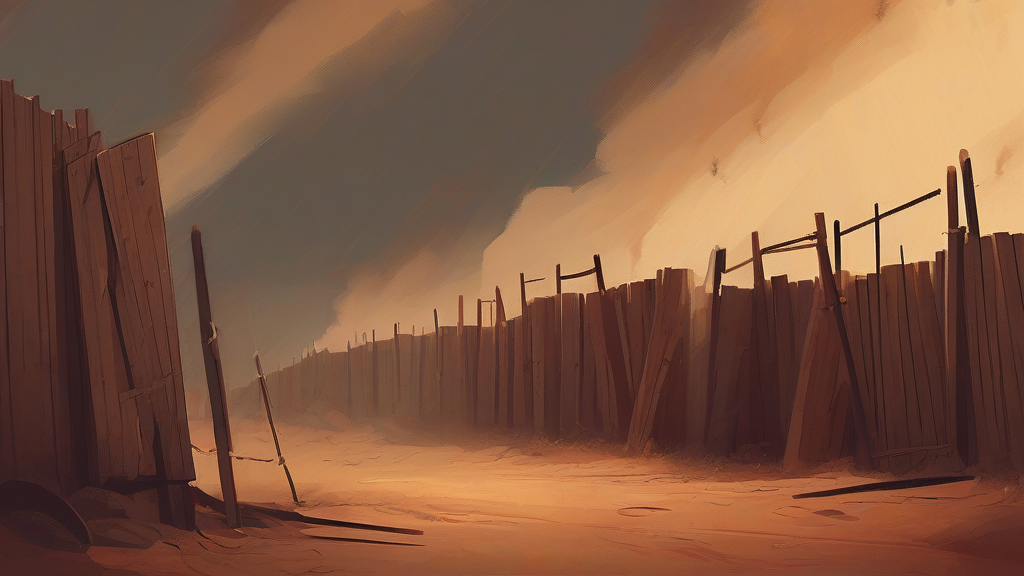
What does barricado mean?
A barricado is a defensive barrier thrown across a street or passage to block movement — typically an improvised structure of overturned carts, barrels, paving stones, and timber. It is the older English form of what we now call a barricade, borrowed in the early seventeenth century from Spanish 'barricada', itself derived from 'barrica', meaning a cask or barrel, since barrels filled with earth were famously used to obstruct streets. The word belongs chiefly to the language of siege, insurrection, and civil unrest, evoking scenes of citizens sealing off their neighborhoods against soldiers. Today it survives mainly in historical writing and in the works of early modern authors such as Shakespeare, whose plays use it in its original form. For everyday purposes, 'barricade' has entirely displaced it, but 'barricado' remains a vivid reminder of how military necessity shapes vocabulary.
A barricade: an improvised barrier of barrels, carts, timber, or debris erected to block a street or passage.
"The crowd raised a barricado of felled trees across the bridge."
Archaic; replaced in modern English by 'barricade'.
To block or defend with a barricade.
"They barricadoed the gates against the advancing cavalry."
Rare and archaic verb form; 'barricade' is used instead today.
The plural follows the standard -o/-oes pattern for words ending in consonant + o.
"Soldiers dismantled the barricadoes one by one as order was restored."
Before 'barricade' won the spelling war, English speakers for decades said 'barricado' — a borrowing straight from Spanish street fighting.
Reviewed by Deb Chak, Editor. AI-assisted content curated by RJS Tech Solutions LLP.
Etymology of barricado
Barricado entered English in the late sixteenth or early seventeenth century from Spanish 'barricada', which derives from 'barrica', a small cask or barrel — reflecting the practice of using earth-filled barrels to block streets during uprisings. The Spanish term itself traces back through Vulgar Latin to 'barra', meaning a bar or rod. Its doublet 'barricade', arriving via French, ultimately won out in standard English, leaving 'barricado' as a historical variant preserved in seventeenth-century literature.
Related word forms
How barricado is actually used
Archaic and rare in modern usage; encountered mainly in historical texts and literature of the seventeenth century. In contemporary writing, 'barricade' is strongly preferred.
Easily confused with barricado
'Barricade' is the modern standard word for a defensive barrier, while 'barricado' is an older, now largely obsolete variant of the same word.